

Cell Balancing Simulator
Compare passive vs active BMS balancing methods for series-connected Li-ion cells
About this Simulator
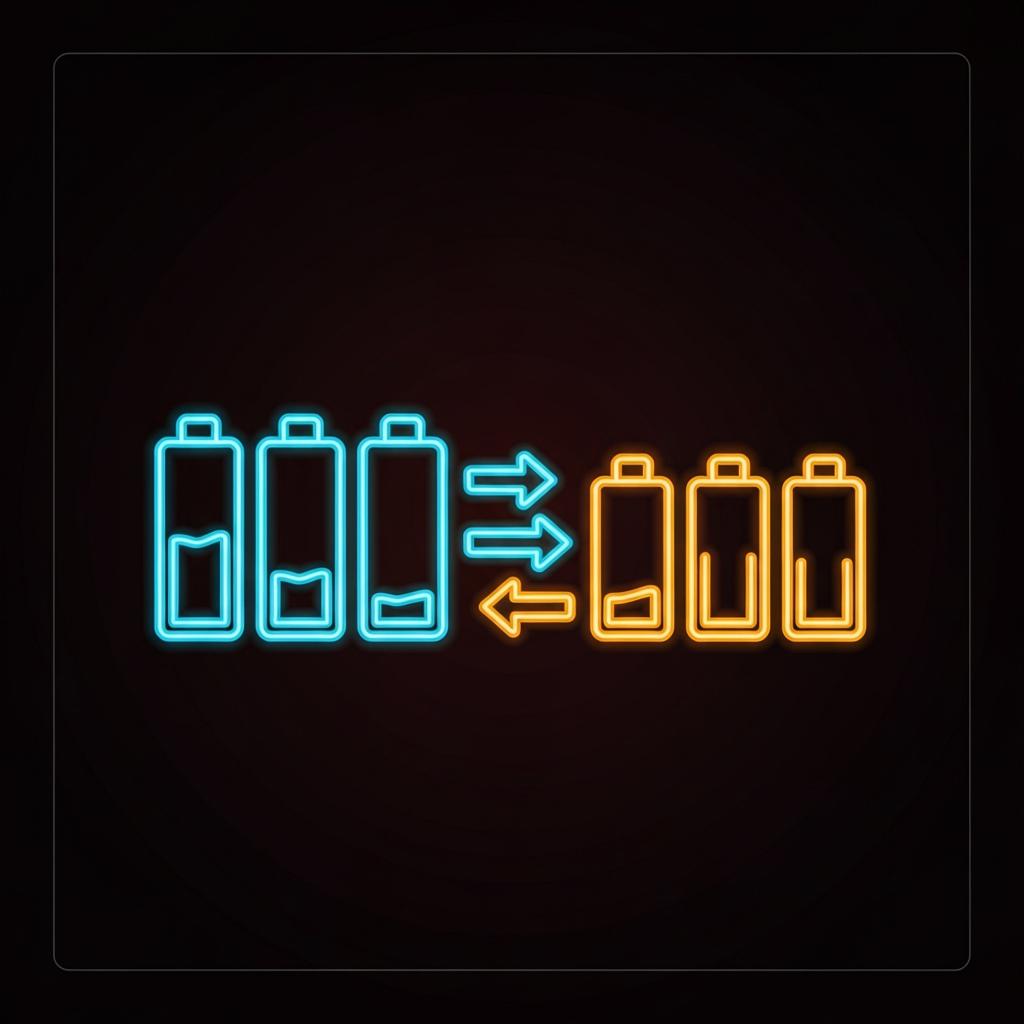
This simulator demonstrates cell balancing in lithium-ion battery packs. In series configurations, cells develop SoC imbalances due to manufacturing variations, temperature differences, and aging. Watch how passive balancing dissipates excess energy as heat, while active balancing efficiently transfers charge between cells. Simulation Parameters — Passive: Rshunt=5Ω, Imax=100mA | Active: Cfly=100μF, fswitch=50kHz, η=92%
Physics & Formulas
Passive Balancing (Resistive):
$$I_{balance} = \frac{V_{cell} - V_{threshold}}{R_{shunt}}$$
$$P_{heat} = I^2 \cdot R_{shunt}$$
Active Balancing (Switched Capacitor):
$$Q_{transfer} = C_{fly} \cdot \Delta V \cdot \eta \cdot f_{switch} \cdot \Delta t$$
OCV-SoC Relationship:
$$V_{OC}(SoC) = 3.0V \text{ to } 4.2V \text{ (Li-ion)}$$
How to Use
- Select number of cells (4-16) to simulate different pack sizes
- Choose balancing method: Passive, Active, or Compare both side-by-side
- Adjust imbalance level and click 'Randomize' to set initial cell states
- Press 'Start/Pause' to run the simulation
- Watch the SoC bars converge and track energy loss in the stats panel
- Toggle 'Show Energy Flow' to see animated charge transfer
- Toggle 'Show Heat' to visualize heat generation in passive mode
Frequently Asked Questions
What is the difference between passive and active balancing?
Passive balancing dissipates excess energy from high-SoC cells as heat through resistors - simple but wasteful (0% efficiency). Active balancing transfers charge from high to low cells using capacitors or inductors - more efficient (90-95%) but more complex and expensive.
Why do cells become imbalanced?
Cell imbalances arise from manufacturing variations in capacity (1-3%), different self-discharge rates, temperature gradients in the pack, and uneven aging. Even small variations compound over hundreds of charge cycles.
What balancing current is typical?
Passive balancing uses 50-200mA to limit heat. Higher currents balance faster but generate more heat, requiring better thermal management. Active balancing can achieve higher effective rates due to its efficiency.
When does balancing occur?
Passive balancing typically occurs only during charging (when cells are near full). Active balancing can work during both charging and discharging, making it more effective for applications with irregular charge patterns.
How does the OCV-SoC curve affect balancing?
The voltage plateau in the 20-80% SoC region makes voltage-based SoC estimation challenging. Small voltage differences can represent large SoC differences. BMS systems combine voltage with coulomb counting for accuracy.
Cell Balancing Build Kit
Build this simulator yourself
Get the complete source code, circuit schematics, and step-by-step documentation to build your own cell balancing simulator from scratch.
What's Included:
- Python physics simulation (NumPy)
- JavaScript Canvas visualization
- Circuit diagrams (passive & active)
- OCV-SoC curves and comparison charts
- Full HTML documentation with KaTeX math