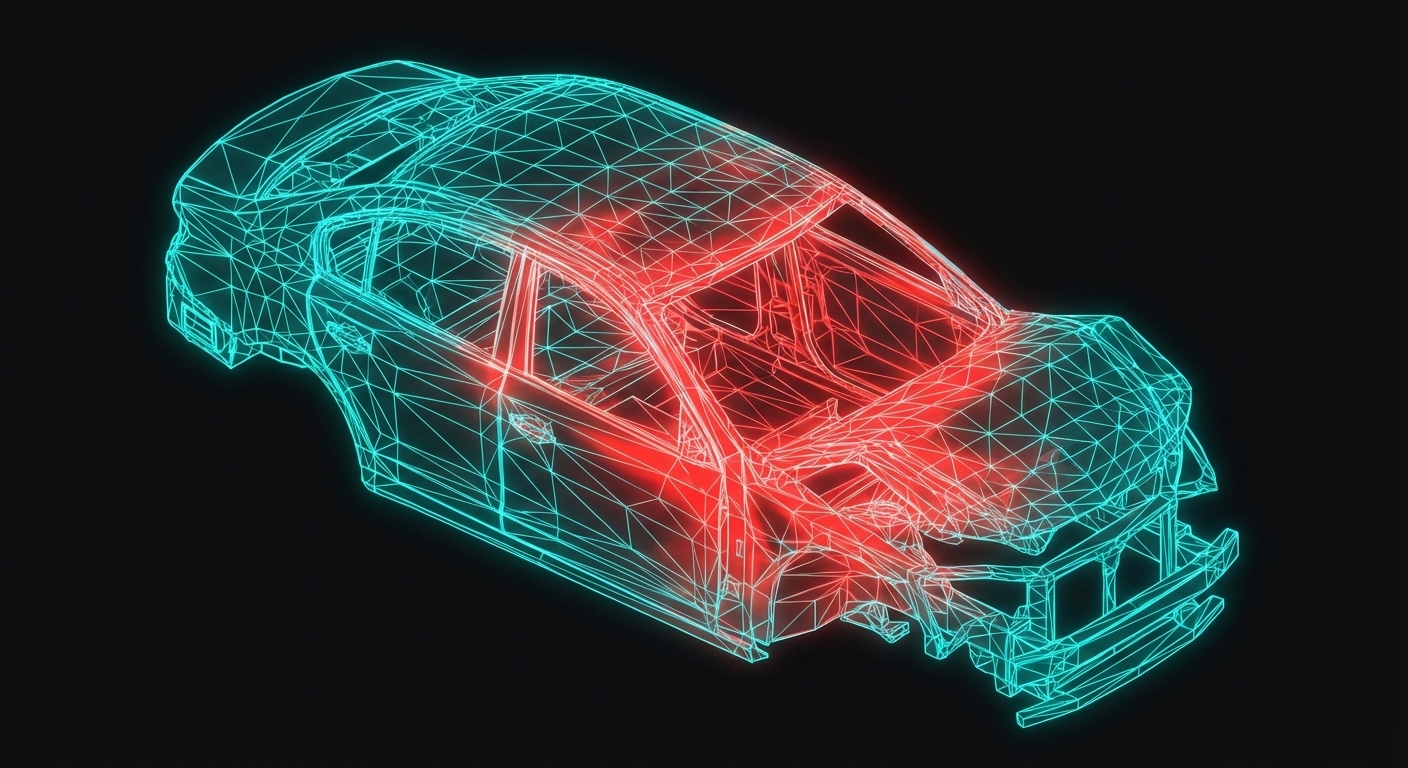
Stress-Strain Analysis
Understanding how materials respond to loading is fundamental to engineering design. In this lesson, we'll explore stress and strain in depth, and build Python tools to analyze material behavior.
Normal Stress
Normal stress acts perpendicular to a surface. It can be:
- Tensile stress ($\sigma > 0$): Material is being pulled apart
- Compressive stress ($\sigma < 0$): Material is being pushed together
$$\sigma = \frac{P}{A}$$
Sponsored
Srinithin now works at Xitadel as Design Engineer
Mechanical engineering graduate turned automotive designer
Example: Tensile Bar Analysis
import numpy as np

def analyze_tensile_bar(force_kN, diameter_mm, length_mm, E_GPa):
    """
    Analyze a circular bar under tensile loading.

    Parameters:
    -----------
    force_kN : float - Applied force in kN
    diameter_mm : float - Bar diameter in mm
    length_mm : float - Bar length in mm
    E_GPa : float - Young's modulus in GPa

    Returns:
    --------
    dict with stress, strain, and elongation
    """
    # Convert units to SI
    P = force_kN * 1e3      # N
    d = diameter_mm * 1e-3  # m
    L = length_mm * 1e-3    # m
    E = E_GPa * 1e9         # Pa

    # Calculate area
    A = np.pi * (d / 2) ** 2

    # Calculate stress
    sigma = P / A

    # Calculate strain (Hooke's Law)
    epsilon = sigma / E

    # Calculate elongation
    delta_L = epsilon * L

    return {
        'area_mm2': A * 1e6,
        'stress_MPa': sigma / 1e6,
        'strain': epsilon,
        'strain_percent': epsilon * 100,
        'elongation_mm': delta_L * 1e3
    }

# Example: Steel rod
result = analyze_tensile_bar(
    force_kN=100,
    diameter_mm=25,
    length_mm=2000,
    E_GPa=200
)

print("Tensile Bar Analysis Results:")
print(f"  Cross-sectional area: {result['area_mm2']:.2f} mm²")
print(f"  Stress: {result['stress_MPa']:.2f} MPa")
print(f"  Strain: {result['strain']:.6f} ({result['strain_percent']:.4f}%)")
print(f"  Elongation: {result['elongation_mm']:.4f} mm")
Output:
Tensile Bar Analysis Results:
  Cross-sectional area: 490.87 mm²
  Stress: 203.72 MPa
  Strain: 0.001019 (0.1019%)
  Elongation: 2.0372 mm
Shear Stress
Shear stress acts parallel to a surface, like when you cut paper with scissors:
$$\tau = \frac{V}{A}$$
Where:
Sponsored
Abhishek landed his dream job at TATA ELXSI
From learning simulations to working at an industry leader
- $\tau$ = Shear stress (Pa)
- $V$ = Shear force (N)
- $A$ = Area parallel to force (m²)
Shear Strain
Shear strain ($\gamma$) measures the angular deformation:
$$\gamma = \frac{\delta}{L} = \tan(\phi) \approx \phi$$ (for small angles)
The relationship between shear stress and strain:
Sponsored
70% of India's auto industry trusts Skill-Lync
For training their engineers in CAD, CAE & simulation
$$\tau = G \cdot \gamma$$
Where $G$ is the Shear Modulus (or Modulus of Rigidity).
Relationship Between E and G
For isotropic materials:
$$G = \frac{E}{2(1 + \nu)}$$
Where $\nu$ is Poisson's ratio (typically 0.25-0.35 for metals).
def calculate_shear_modulus(E_GPa, poisson_ratio):
    """Calculate shear modulus from Young's modulus and Poisson's ratio."""
    G = E_GPa / (2 * (1 + poisson_ratio))
    return G

# Steel properties
E_steel = 200  # GPa
nu_steel = 0.3

G_steel = calculate_shear_modulus(E_steel, nu_steel)
print(f"Steel: E = {E_steel} GPa, ν = {nu_steel}")
print(f"Shear modulus G = {G_steel:.1f} GPa")

# Aluminum properties
E_al = 70  # GPa
nu_al = 0.33

G_al = calculate_shear_modulus(E_al, nu_al)
print(f"\nAluminum: E = {E_al} GPa, ν = {nu_al}")
print(f"Shear modulus G = {G_al:.1f} GPa")
Poisson's Ratio
When you stretch a rubber band, it gets thinner. This coupling between axial and lateral strain is captured by Poisson's ratio:
$$\nu = -\frac{\varepsilon_{lateral}}{\varepsilon_{axial}}$$
def calculate_lateral_contraction(
    force_kN, diameter_mm, length_mm, E_GPa, poisson_ratio
):
    """
    Calculate lateral contraction due to axial loading.
    """
    # Axial analysis
    P = force_kN * 1e3
    d = diameter_mm * 1e-3
    A = np.pi * (d / 2) ** 2
    E = E_GPa * 1e9

    sigma = P / A
    epsilon_axial = sigma / E

    # Lateral strain (negative = contraction)
    epsilon_lateral = -poisson_ratio * epsilon_axial

    # Change in diameter
    delta_d = epsilon_lateral * d

    return {
        'axial_strain': epsilon_axial,
        'lateral_strain': epsilon_lateral,
        'diameter_change_mm': delta_d * 1e3,
        'new_diameter_mm': (d + delta_d) * 1e3
    }

# Steel bar under tension
result = calculate_lateral_contraction(
    force_kN=100,
    diameter_mm=25,
    length_mm=2000,
    E_GPa=200,
    poisson_ratio=0.3
)

print("Lateral Contraction Analysis:")
print(f"  Axial strain: {result['axial_strain']:.6f}")
print(f"  Lateral strain: {result['lateral_strain']:.6f}")
print(f"  Diameter change: {result['diameter_change_mm']:.6f} mm")
print(f"  New diameter: {result['new_diameter_mm']:.6f} mm")
Stress-Strain Curves
Different materials exhibit different stress-strain behavior. Let's visualize them:
import numpy as np
import matplotlib.pyplot as plt

def plot_stress_strain_curves():
    """Plot stress-strain curves for different materials."""

    fig, axes = plt.subplots(1, 2, figsize=(14, 5))

    # ===== Ductile Material (Steel) =====
    ax1 = axes[0]

    # Material properties
    E = 200e3  # MPa
    sigma_y = 250  # MPa (yield)
    sigma_u = 400  # MPa (ultimate)
    epsilon_u = 0.15  # Strain at ultimate
    epsilon_f = 0.25  # Strain at fracture

    # Elastic region
    eps1 = np.linspace(0, sigma_y / E, 50)
    sig1 = E * eps1

    # Yield plateau
    eps2 = np.linspace(sigma_y / E, 0.02, 20)
    sig2 = np.ones_like(eps2) * sigma_y

    # Strain hardening
    eps3 = np.linspace(0.02, epsilon_u, 50)
    sig3 = sigma_y + (sigma_u - sigma_y) * ((eps3 - 0.02) / (epsilon_u - 0.02)) ** 0.5

    # Necking
    eps4 = np.linspace(epsilon_u, epsilon_f, 30)
    sig4 = sigma_u - 150 * ((eps4 - epsilon_u) / (epsilon_f - epsilon_u)) ** 2

    # Plot steel curve
    ax1.plot(eps1 * 100, sig1, 'b-', linewidth=2)
    ax1.plot(eps2 * 100, sig2, 'b-', linewidth=2)
    ax1.plot(eps3 * 100, sig3, 'b-', linewidth=2)
    ax1.plot(eps4 * 100, sig4, 'b-', linewidth=2, label='Mild Steel')

    # Annotations
    ax1.annotate('Yield Point', xy=(sigma_y/E*100, sigma_y),
                 xytext=(3, 280), fontsize=10,
                 arrowprops=dict(arrowstyle='->', color='gray'))
    ax1.annotate('Ultimate\nStrength', xy=(epsilon_u*100, sigma_u),
                 xytext=(18, 420), fontsize=10,
                 arrowprops=dict(arrowstyle='->', color='gray'))
    ax1.annotate('Fracture', xy=(epsilon_f*100, sig4[-1]),
                 xytext=(27, 200), fontsize=10,
                 arrowprops=dict(arrowstyle='->', color='gray'))

    ax1.set_xlabel('Strain (%)', fontsize=12)
    ax1.set_ylabel('Stress (MPa)', fontsize=12)
    ax1.set_title('Ductile Material (Mild Steel)', fontsize=14)
    ax1.grid(True, alpha=0.3)
    ax1.set_xlim(0, 30)
    ax1.set_ylim(0, 500)

    # ===== Brittle Material (Cast Iron) =====
    ax2 = axes[1]

    # Cast iron - almost linear to fracture
    E_ci = 100e3  # MPa
    sigma_f = 200  # MPa (fracture)
    epsilon_f_ci = 0.003  # Very small strain at fracture

    eps_ci = np.linspace(0, epsilon_f_ci, 100)
    # Slightly nonlinear
    sig_ci = sigma_f * (1 - (1 - eps_ci / epsilon_f_ci) ** 2)

    ax2.plot(eps_ci * 100, sig_ci, 'r-', linewidth=2, label='Cast Iron')
    ax2.scatter([epsilon_f_ci * 100], [sigma_f], color='red', s=100, zorder=5)
    ax2.annotate('Sudden\nFracture', xy=(epsilon_f_ci*100, sigma_f),
                 xytext=(0.5, 150), fontsize=10,
                 arrowprops=dict(arrowstyle='->', color='gray'))

    ax2.set_xlabel('Strain (%)', fontsize=12)
    ax2.set_ylabel('Stress (MPa)', fontsize=12)
    ax2.set_title('Brittle Material (Cast Iron)', fontsize=14)
    ax2.grid(True, alpha=0.3)
    ax2.set_xlim(0, 0.5)
    ax2.set_ylim(0, 250)

    plt.tight_layout()
    plt.show()

plot_stress_strain_curves()
True Stress vs Engineering Stress
Engineering stress uses the original area:
$$\sigma_{eng} = \frac{P}{A_0}$$
True stress uses the instantaneous area:
$$\sigma_{true} = \frac{P}{A} = \sigma_{eng}(1 + \varepsilon_{eng})$$
def compare_engineering_true_stress():
    """Compare engineering and true stress-strain curves."""

    # Engineering strain range
    eps_eng = np.linspace(0, 0.3, 100)

    # Simplified engineering stress (power law hardening after yield)
    sigma_y = 250  # MPa
    eps_y = 0.00125
    K = 600  # Strength coefficient
    n = 0.2  # Strain hardening exponent

    sigma_eng = np.where(
        eps_eng < eps_y,
        eps_eng * 200e3,  # Elastic
        K * eps_eng ** n   # Plastic (Hollomon equation)
    )

    # True stress and strain
    eps_true = np.log(1 + eps_eng)
    sigma_true = sigma_eng * (1 + eps_eng)

    # Plot
    plt.figure(figsize=(10, 6))
    plt.plot(eps_eng * 100, sigma_eng, 'b-', linewidth=2, label='Engineering')
    plt.plot(eps_true * 100, sigma_true, 'r--', linewidth=2, label='True')

    plt.xlabel('Strain (%)', fontsize=12)
    plt.ylabel('Stress (MPa)', fontsize=12)
    plt.title('Engineering vs True Stress-Strain', fontsize=14)
    plt.legend(fontsize=11)
    plt.grid(True, alpha=0.3)
    plt.xlim(0, 35)
    plt.show()

compare_engineering_true_stress()
Factor of Safety
The Factor of Safety (FoS) ensures structures can handle unexpected loads:
$$FoS = \frac{\sigma_{allowable}}{\sigma_{working}}$$
| Application | Typical FoS |
|---|
| Aircraft structures | 1.5 - 2.0 |
| Pressure vessels | 3.0 - 4.0 |
| Building structures | 2.0 - 3.0 |
| Elevators | 8.0 - 10.0 |
def design_with_safety_factor(
    required_load_kN,
    yield_strength_MPa,
    factor_of_safety,
    material_name="Steel"
):
    """
    Design a circular rod with given safety factor.
    """
    # Allowable stress
    sigma_allow = yield_strength_MPa / factor_of_safety

    # Required area
    P = required_load_kN * 1e3  # N
    A_required = P / (sigma_allow * 1e6)  # m²

    # Required diameter
    d_required = 2 * np.sqrt(A_required / np.pi)

    # Round up to standard size (mm)
    standard_sizes = [6, 8, 10, 12, 14, 16, 18, 20, 22, 25, 28, 30, 32, 36, 40]
    d_mm = d_required * 1e3
    d_selected = next((s for s in standard_sizes if s >= d_mm), standard_sizes[-1])

    # Actual safety factor with selected size
    A_actual = np.pi * (d_selected * 1e-3 / 2) ** 2
    sigma_actual = P / A_actual
    FoS_actual = (yield_strength_MPa * 1e6) / sigma_actual

    print(f"Design for {required_load_kN} kN load with FoS = {factor_of_safety}")
    print(f"Material: {material_name} (σy = {yield_strength_MPa} MPa)")
    print(f"Allowable stress: {sigma_allow:.1f} MPa")
    print(f"Required diameter: {d_mm:.2f} mm")
    print(f"Selected standard size: {d_selected} mm")
    print(f"Actual stress: {sigma_actual/1e6:.1f} MPa")
    print(f"Actual FoS: {FoS_actual:.2f}")

    return d_selected

# Design example
diameter = design_with_safety_factor(
    required_load_kN=75,
    yield_strength_MPa=250,
    factor_of_safety=2.5,
    material_name="ASTM A36 Steel"
)
Key Takeaways
- Normal stress acts perpendicular; shear stress acts parallel to surfaces
- Poisson's ratio couples axial and lateral strains: $\nu = -\varepsilon_{lat}/\varepsilon_{axial}$
- Shear modulus: $G = E / [2(1+\nu)]$
- Ductile materials show yielding and plastic deformation before failure
- Brittle materials fail suddenly with little plastic deformation
- True stress accounts for area change: $\sigma_{true} = \sigma_{eng}(1 + \varepsilon_{eng})$
- Factor of Safety provides margin against unexpected loads
Next lesson: We'll apply these concepts to axial loading problems including thermal stress.