

Vehicle Design Interview Questions
Body-in-white, chassis design, packaging, crashworthiness, and aerodynamics
1 What is Body-in-White (BIW) and what components does it include?
Easy
What is Body-in-White (BIW) and what components does it include?
Body-in-White refers to the vehicle body structure before painting and trim installation. It includes the underbody floor pan, side structures (A, B, C pillars), roof, front and rear body sections, and reinforcements. BIW excludes doors, hood, trunk lid, fenders (closure panels), and all interior/exterior trim. The BIW is the primary structural backbone of the vehicle, providing crash protection, mounting points for all systems, and contributing to overall vehicle stiffness.
2 What is the difference between monocoque and body-on-frame construction?
Easy
What is the difference between monocoque and body-on-frame construction?
Monocoque (unibody) construction integrates the body and frame into a single structure where body panels contribute to overall rigidity. It offers better handling, lighter weight, and more efficient packaging for passenger cars. Body-on-frame has a separate ladder frame supporting the body, offering higher load capacity, easier repair, and durability for trucks and SUVs. Most modern cars use monocoque, while pickup trucks and off-road vehicles often use body-on-frame.
3 What are crumple zones and how do they protect occupants in a crash?
Easy
What are crumple zones and how do they protect occupants in a crash?
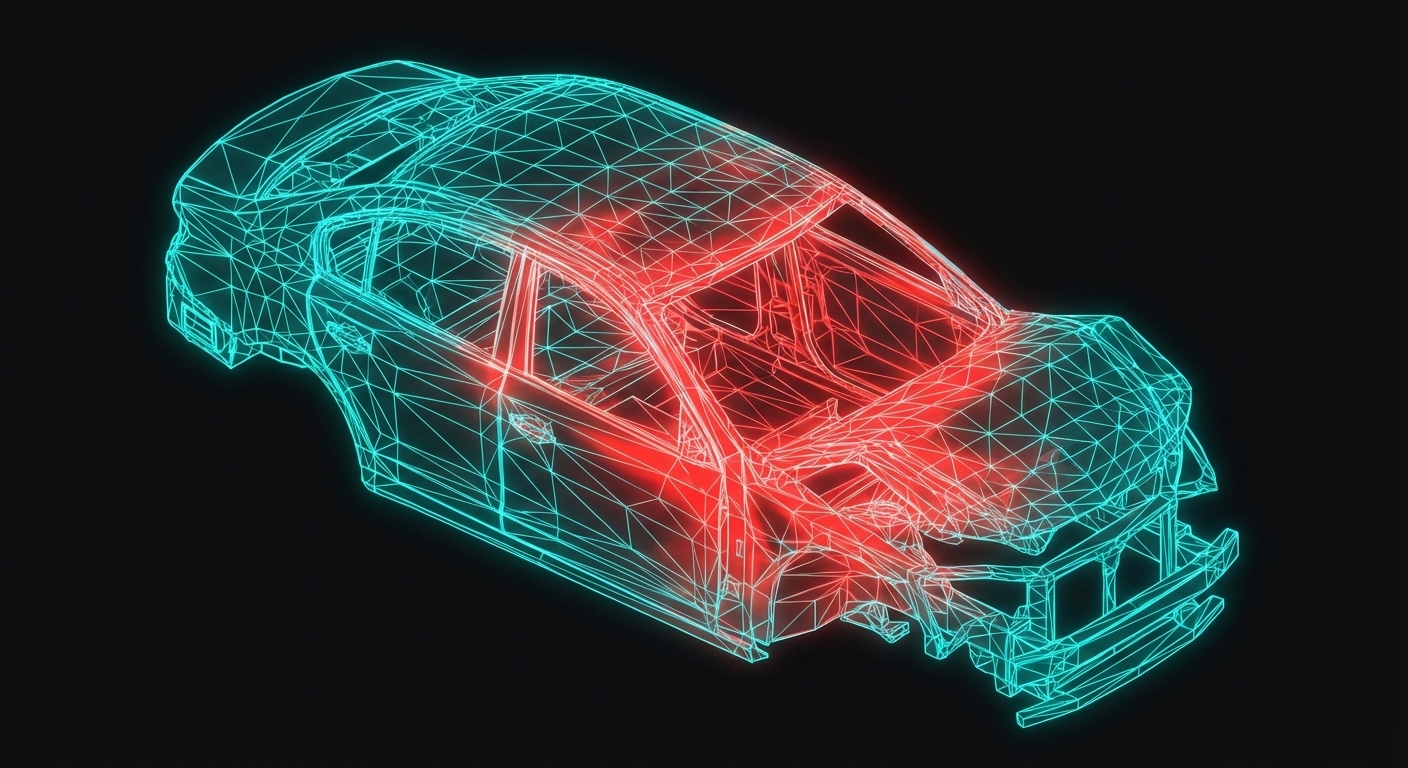
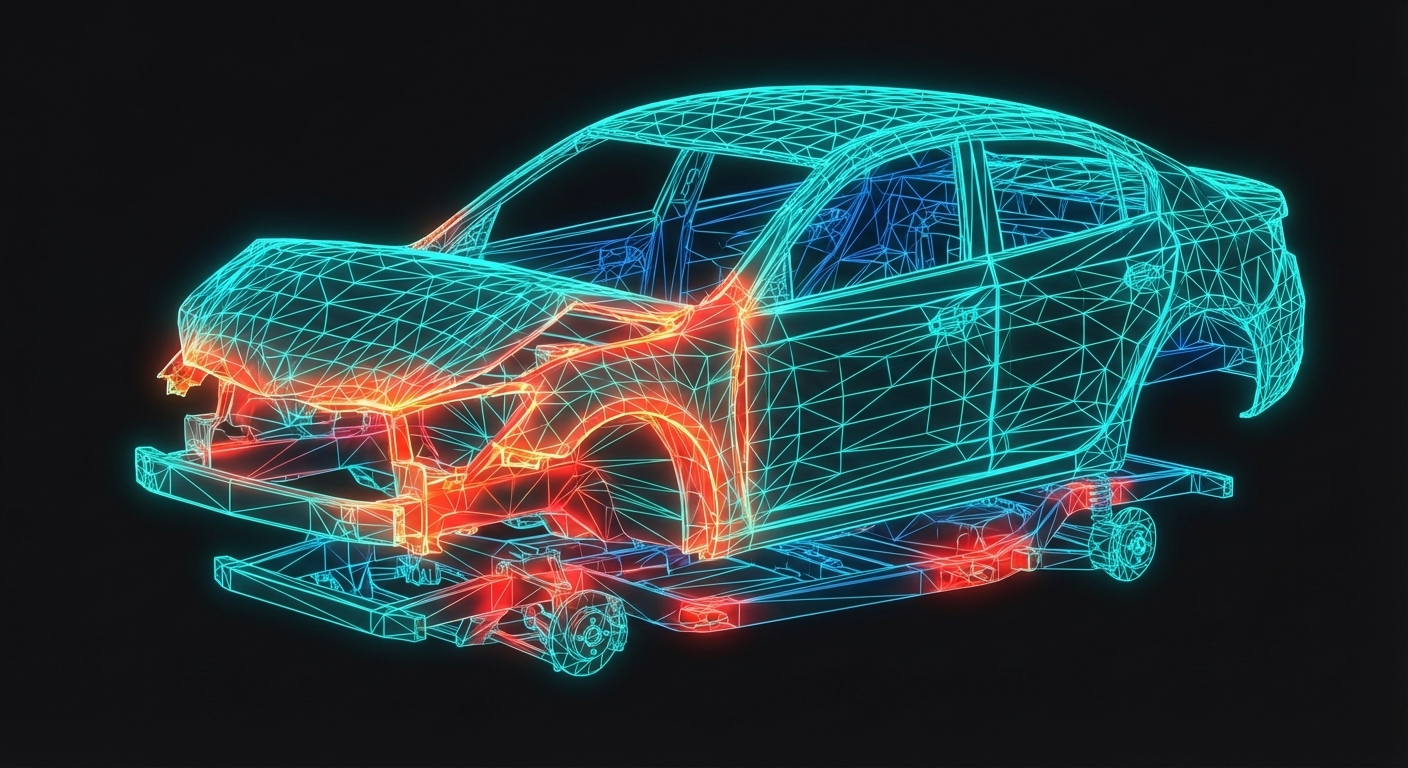
Crumple zones are engineered front and rear sections designed to deform progressively in a collision, absorbing kinetic energy through controlled collapse. By extending the deceleration time and distance, they reduce the peak forces transmitted to the occupant compartment. The passenger cell remains rigid while crumple zones collapse in a predictable manner, converting kinetic energy into deformation energy and reducing occupant deceleration below injury thresholds.
4 What is drag coefficient (Cd) and why is it important for vehicle design?
Easy
What is drag coefficient (Cd) and why is it important for vehicle design?
Drag coefficient is a dimensionless number representing aerodynamic resistance, typically ranging from 0.25-0.40 for modern cars. Lower Cd means less air resistance, improving fuel efficiency and top speed. At highway speeds, aerodynamic drag is the dominant resistance force. Reducing Cd by 10% can improve fuel economy by 3-5%. Modern efficient sedans achieve Cd around 0.25-0.28, while SUVs are typically 0.35-0.40.
5 What are the A, B, and C pillars on a vehicle and what are their functions?
Easy
What are the A, B, and C pillars on a vehicle and what are their functions?
Pillars are vertical structural supports connecting the roof to the body: A-pillar (windshield pillar) frames the windshield and protects in frontal crashes; B-pillar is between front and rear doors, providing side impact protection and door latching; C-pillar supports the rear of the roof. On SUVs/wagons, there may be a D-pillar at the rear. Pillars must balance structural strength with visibility requirements and contribute significantly to overall body stiffness and crash safety.
Get IIT Jammu PG Certification
Master these concepts with 175+ hours of industry projects and hands-on training.
6 Why is high-strength steel (HSS) used in modern vehicle bodies?
Easy
Why is high-strength steel (HSS) used in modern vehicle bodies?
High-strength steel allows thinner, lighter panels while maintaining or improving strength compared to conventional steel. It enables vehicle lightweighting while meeting stringent crash safety standards and managing cost. Various grades include HSLA (High-Strength Low Alloy), dual-phase (DP), TRIP, and press-hardened/hot-stamped steels (up to 1500 MPa). HSS is used strategically in safety-critical areas like B-pillars, rockers, and front rails to optimize the strength-to-weight ratio.
7 What is vehicle packaging and what are its main considerations?
Easy
What is vehicle packaging and what are its main considerations?
Vehicle packaging is the process of efficiently arranging all components and occupants within the vehicle envelope. Key considerations include occupant accommodation (headroom, legroom, ingress/egress), component placement (engine, battery, fuel tank), structural requirements, crash clearances, serviceability access, and manufacturing feasibility. Packaging requires balancing competing demands - for example, maximizing interior space while minimizing exterior dimensions, or optimizing aero shape while maintaining visibility.
8 How do vehicles protect occupants in side impacts?
Easy
How do vehicles protect occupants in side impacts?
Side impact protection uses multiple strategies: Reinforced door structures with impact beams, B-pillar reinforcement with high-strength steel, padded interior surfaces to reduce head injury, side airbags and curtain airbags, seat-mounted pelvic airbags, and robust rocker/sill structures. Since side impact intrusion distance is limited (no crumple zone like frontal), the focus is on strong structures to prevent intrusion and airbags to cushion occupant contact with intruding surfaces.
9 What are the advantages and challenges of using aluminum in vehicle bodies?
Easy
What are the advantages and challenges of using aluminum in vehicle bodies?
Aluminum offers significant weight savings (up to 40% vs steel for equivalent strength) and excellent corrosion resistance. It is used in closures (hoods, doors), structural components, and full aluminum bodies in premium vehicles. Challenges include higher material cost (3-4x steel), more complex joining techniques (riveting, adhesive bonding, FSW), higher springback in stamping, and galvanic corrosion when contacting steel. The weight savings improve fuel economy and EV range.
10 What is torsional stiffness and why is it important for vehicle bodies?
Easy
What is torsional stiffness and why is it important for vehicle bodies?
Torsional stiffness measures a body's resistance to twisting, typically expressed in Nm/degree. Higher torsional stiffness improves handling precision and predictability, reduces body flex that affects door alignment and sealing, enhances ride quality by allowing suspension to work properly, and reduces NVH issues like rattles and squeaks. Modern cars target 20,000-30,000 Nm/degree; sports cars may exceed 40,000 Nm/degree for sharper handling response.
11 How are modern vehicle hoods designed for pedestrian protection?
Easy
How are modern vehicle hoods designed for pedestrian protection?
Pedestrian protection requires hoods to absorb impact energy and create clearance from hard components underneath. Design features include increased hood-to-engine clearance (typically >60mm), cone and bead patterns in inner panels for controlled deformation, soft mounting systems, and active hood lift systems that raise the hood in pedestrian impacts. Materials choice (aluminum vs steel) and inner panel design must allow energy absorption while meeting other requirements like flutter resistance and dent resistance.
12 What factors influence ground clearance decisions in vehicle design?
Easy
What factors influence ground clearance decisions in vehicle design?
Ground clearance affects off-road capability, aerodynamics, ingress/egress, and ride comfort. Higher clearance improves off-road ability and floodwater wading but increases center of gravity and aerodynamic drag. Lower clearance improves aero and handling but limits rough road capability. Typical values: sports cars 100-120mm, sedans 140-160mm, crossovers 170-200mm, off-road SUVs 220-280mm. Air suspension can provide variable clearance to optimize for different conditions.
13 What is aerodynamic downforce and how is it generated?
Easy
What is aerodynamic downforce and how is it generated?
Downforce is aerodynamic force pushing the vehicle toward the ground, improving tire grip without adding weight. It is generated by creating low pressure above the body (shaped like inverted wing), rear spoilers/wings deflecting airflow upward, flat underbody with rear diffuser, and front splitters. Performance cars may generate hundreds of kilograms of downforce at high speed. The trade-off is increased drag; active aerodynamics can optimize this balance by adjusting elements at different speeds.
14 What is a subframe and what functions does it serve?
Easy
What is a subframe and what functions does it serve?
A subframe is a structural component that mounts to the main body and supports the suspension, steering, and sometimes powertrain components. It provides a rigid mounting platform, isolates road and powertrain NVH from the body through rubber mounts, simplifies assembly by allowing suspension pre-assembly, and can be made from different materials than the body. Front subframes typically carry the front suspension and steering; rear subframes support the rear suspension and differential.
15 What are the major crash test protocols and what do they evaluate?
Easy
What are the major crash test protocols and what do they evaluate?
Major protocols include: NCAP programs (Euro NCAP, IIHS, NHTSA) evaluating frontal offset, full frontal, side impact, pole impact, and pedestrian protection. Tests use instrumented dummies measuring head, neck, chest, pelvis, and leg injuries. Results inform star ratings that influence consumer decisions. Tests also evaluate post-crash safety (fuel leakage, door opening) and active safety systems like automatic emergency braking. Manufacturers design to meet or exceed these protocols across global markets.
3,000+ Engineers Placed at Top Companies
Join Bosch, Tata Motors, L&T, Mahindra and 500+ hiring partners.
16 How do you design load paths in a vehicle body structure for crash performance?
Medium
How do you design load paths in a vehicle body structure for crash performance?
Load path design involves creating multiple continuous structural members that channel crash energy from impact point to reinforced nodes where energy is distributed and absorbed. For frontal crashes, primary paths run through front rails to rockers and floor; secondary paths through upper rails and A-pillars. Design principles include maintaining path continuity without sudden section changes, using branching to distribute loads, avoiding load path convergence that creates stress concentrations, and including trigger mechanisms for controlled collapse initiation. Analysis uses CAE simulation to verify energy flow and optimize member sizing.
17 What are the challenges and solutions for joining mixed materials in vehicle bodies?
Medium
What are the challenges and solutions for joining mixed materials in vehicle bodies?
Mixed material bodies combining steel, aluminum, composites, and magnesium present joining challenges: Galvanic corrosion (managed with isolation barriers, e-coat, sealers), different thermal expansion causing stress (addressed with flexible adhesives), incompatibility with welding (using mechanical fasteners like SPR, FDS, clinching), and different stiffness causing load distribution issues. Solutions include structural adhesive bonding providing continuous joints, self-pierce riveting for aluminum-to-steel, flow drill screws, friction element welding, and hybrid approaches combining mechanical fasteners with adhesive for redundancy.
18 How is vehicle aerodynamics developed from concept to production?
Medium
How is vehicle aerodynamics developed from concept to production?
Aerodynamic development begins with CFD analysis in concept phase evaluating overall shape, followed by scale model wind tunnel testing to validate CFD and explore alternatives. Production development uses full-scale clay models in wind tunnels for fine-tuning with real wheels and underbody. Key focus areas include front end (cooling drag), underbody (flat floor, diffuser), rear end (wake management), wheels/tires, and A-pillar/mirror flow. Development includes thermal management (cooling airflow), soiling/water management, and aero-acoustics. Final validation uses production vehicles in wind tunnel and on-road coast-down testing.
19 What is hot stamping and why is it used for body components?
Medium
What is hot stamping and why is it used for body components?
Hot stamping (press hardening) heats steel blanks to ~900C, then rapidly forms and quenches them in water-cooled dies. The process creates martensitic steel with tensile strength up to 1500 MPa, much higher than cold-formed alternatives. It enables complex shapes with minimal springback and high dimensional accuracy. Used for safety-critical components like B-pillars, front rails, door rings, and bumper beams where maximum strength-to-weight ratio is needed. Challenges include higher tooling cost, cycle time, coating management, and limited post-forming modification.
20 What is a vehicle platform/architecture and what are its business benefits?
Medium
What is a vehicle platform/architecture and what are its business benefits?
A vehicle platform/architecture is a common set of structural components, hardpoints, and systems shared across multiple vehicle models. Key shared elements include floor structure, suspension geometry, powertrain mounting, and electrical architecture. Business benefits include reduced development cost (spread across models), shorter development time, quality improvements through validation across higher volumes, manufacturing efficiency (shared tooling, common parts), and simplified supply chain. Modern modular platforms (like VW MQB, Toyota TNGA) can span vehicle sizes and powertrain types.
21 How do you design for small overlap frontal crash performance?
Medium
How do you design for small overlap frontal crash performance?
Small overlap crashes (like IIHS 25% offset) bypass main front rail structures, presenting unique challenges. Design strategies include: Extended bumper beam coverage, diagonal reinforcement connecting bumper to main rail, robust A-pillar base and hinge pillar, shotgun (front fender reinforcement) structures for secondary load path, door-mounted beams engaging B-pillar, and restraint system optimization for oblique loading. The goal is engaging vehicle structure rather than allowing wheel intrusion and maintaining occupant compartment integrity despite offset load path.
22 How do electric vehicle body structures differ from conventional vehicles?
Medium
How do electric vehicle body structures differ from conventional vehicles?
EV body structures must address: Battery packaging (typically floor-mounted requiring low floor/high sills), battery crash protection (reinforced rocker panels, front/rear structures preventing intrusion), high torsional stiffness (battery as structural element), different weight distribution (batteries concentrated low/center), no engine bay constraints enabling new crumple zone designs, and high-voltage safety isolation. Opportunities include skateboard platforms, lower center of gravity improving handling, and battery as structural member increasing stiffness. Challenges include higher mass requiring stronger structures and repair complexity.
23 How do you optimize underbody aerodynamics for efficiency?
Medium
How do you optimize underbody aerodynamics for efficiency?
Underbody aerodynamics significantly affects Cd and lift. Optimization strategies include: Flat underbody panels covering rough components, smooth transitions from front bumper to floor, front air dam to reduce flow under vehicle, rear diffuser recovering pressure and reducing drag, wheel deflectors managing tire spray and flow, exhaust system integration without flow obstruction, and proper sealing around suspension openings. Active underbody elements can deploy at speed for improved efficiency while maintaining ground clearance at low speed. Underbody development requires balancing aero with cooling, exhaust routing, and service access.
24 What are the applications and challenges of carbon fiber reinforced plastics (CFRP) in vehicles?
Medium
What are the applications and challenges of carbon fiber reinforced plastics (CFRP) in vehicles?
CFRP offers the best strength-to-weight ratio but is expensive. Applications include roof panels, structural components in supercars, driveshafts, and trim pieces. BMW i3/i8 pioneered high-volume CFRP body structures. Challenges include high material and manufacturing cost, long cycle times (addressed by HP-RTM, press forming), joining to metals, repairability concerns, recyclability issues, and crash energy absorption characteristics (brittle failure). Hybrid approaches using CFRP with metal reinforcements balance performance and practicality.
25 What is the H-point and how is it used in vehicle interior design?
Medium
What is the H-point and how is it used in vehicle interior design?
The H-point (hip point) is the theoretical pivot point between torso and upper leg of a seated occupant, representing hip joint location. It serves as the key reference for interior design, determining seat height, steering wheel position, pedal location, and sightlines. H-point location is defined using SAE J826 manikin tools. Package optimization involves balancing H-point height (lower for sporty feel, higher for ease of entry) with other accommodation requirements while maintaining proper relationship to ground, controls, and vision zones.

Harshal
Fiat Chrysler

Abhishek
TATA ELXSI

Srinithin
Xitadel

Ranjith
Core Automotive

Gaurav
Automotive Company

Bino
Design Firm

Aseem
EV Company

Puneet
Automotive Company

Vishal
EV Startup
More Success Stories
26 How do you optimize body structure for stiffness while minimizing weight?
Medium
How do you optimize body structure for stiffness while minimizing weight?
Stiffness optimization involves: Topology optimization identifying efficient load paths, closed-section design for torsional efficiency, strategic reinforcement placement at high-stress nodes, material selection matching properties to local requirements (high-strength steel in critical areas), beading and embossing patterns increasing panel stiffness without mass, joint design maximizing stiffness transfer, and avoiding stress concentrations. CAE tools analyze mode shapes and identify areas contributing most to stiffness; design changes are evaluated for stiffness-to-weight efficiency ratio. The goal is meeting stiffness targets with minimum mass addition.
27 What is crash compatibility and how is it addressed in vehicle design?
Medium
What is crash compatibility and how is it addressed in vehicle design?
Crash compatibility ensures vehicles of different sizes protect occupants in collisions with each other. Key aspects include geometric compatibility (aligning energy-absorbing structures vertically - typically 400-500mm from ground), stiffness compatibility (not having one vehicle too stiff causing other to absorb all energy), and mass compatibility (managing higher deceleration in lighter vehicle). Regulations like EC frontal impact include MPDB (mobile progressive deformable barrier) that penalizes aggressive structures. Design balances self-protection with partner protection.
28 What are active aerodynamics systems and how do they improve vehicle performance?
Medium
What are active aerodynamics systems and how do they improve vehicle performance?
Active aerodynamics systems adjust aerodynamic elements based on driving conditions. Examples include: Active grille shutters (close at speed for reduced drag, open for cooling), active rear spoilers (deploy at high speed for downforce, retract for efficiency), active ride height (lower at speed for reduced drag), and active underbody panels. Control strategies consider vehicle speed, engine/battery temperature, and driving mode. Benefits include optimizing the drag-downforce trade-off at different speeds, typically providing 5-10% drag reduction while maintaining cooling and stability when needed.
29 What are tailor-welded blanks and what are their advantages in body manufacturing?
Medium
What are tailor-welded blanks and what are their advantages in body manufacturing?
Tailor-welded blanks (TWB) join different thickness or grade steel sheets before stamping, allowing material properties to be optimized locally within a single panel. For example, B-pillar blanks combine thick upper section for head protection with thinner lower section for leg room while maintaining continuous crash performance. Advantages include weight reduction (material only where needed), improved crash performance, reduced part count, and better material utilization. Challenges include controlling weld line position during forming and ensuring weld quality/consistency.
30 How are anthropometric percentiles used in vehicle occupant accommodation?
Medium
How are anthropometric percentiles used in vehicle occupant accommodation?
Anthropometric percentiles describe human body dimension distributions used to ensure vehicles accommodate diverse populations. Typically, design targets 5th percentile female to 95th percentile male for critical dimensions (covering ~90% of adult population). Key applications include seat travel range, steering wheel adjustment, headroom, legroom, reach to controls, and sightlines. Different markets may require different reference populations. Package engineers use SAE J826 manikins and digital human models to verify accommodation. Trade-offs balance accommodation breadth against vehicle size and design constraints.
31 How do you design for roof crush resistance in rollover accidents?
Medium
How do you design for roof crush resistance in rollover accidents?
Roof crush design focuses on maintaining occupant survival space during rollover. Key elements include: Strong A, B, C pillars (often hot-stamped steel), continuous load paths from pillars through roof rail to opposite pillars, roof bows for lateral stiffness, reinforced header and backlight openings, and connection stiffness to floor structure. FMVSS 216 requires withstanding 3x vehicle weight. Design uses CAE quasi-static analysis validated with physical testing. Balancing roof strength with weight, visibility (pillar thickness), and manufacturing is critical. Roof-mounted components like panoramic sunroofs add complexity.
32 How is wind noise (aeroacoustics) addressed in vehicle development?
Medium
How is wind noise (aeroacoustics) addressed in vehicle development?
Aeroacoustic development targets reducing wind noise reaching occupants. Key areas include: A-pillar and mirror shape (managing separated flow), door/window seals (preventing leak paths), rain gutter design, roof rack integration, and surface smoothness. Development uses wind tunnel testing with acoustic instrumentation, CFD-based acoustic simulation, and on-road evaluation. Solutions include optimized pillar/mirror shapes, acoustic sealing systems, acoustic glass, and cabin insulation. Interior noise targets (typically 65-70 dB at highway speed for luxury vehicles) drive refinement of exterior shape and sealing systems.
33 What are the applications and challenges of magnesium in automotive structures?
Medium
What are the applications and challenges of magnesium in automotive structures?
Magnesium is the lightest structural metal (35% lighter than aluminum) used in instrument panel beams, steering column brackets, seat frames, and closures. Challenges include flammability during processing, galvanic corrosion requiring coatings and isolation, lower strength and ductility than aluminum, limited formability, and higher cost. Modern alloys and processing (die casting, sheet forming) address some limitations. Applications are growing, particularly in instrument panel structures and door inners where weight savings directly improve vehicle dynamics and efficiency.
34 What are the key considerations in designing vehicle closure systems (doors, hood, trunk)?
Medium
What are the key considerations in designing vehicle closure systems (doors, hood, trunk)?
Closure design considerations include: Structural requirements (door impact beam, hinge stiffness, latch strength), sealing (weather protection, acoustic isolation), kinematics (swing arc, clearance, effort), mass (affects door sag, hinge wear), safety (child locks, anti-pinch), and perceived quality (sound, effort, feel). Doors must support window regulators, mirrors, speakers while meeting crash and NVH requirements. Latching systems require reliable engagement, easy release, and crash-rated strength. Design balances all requirements while meeting opening/closing effort targets (typically 30-50 N).
35 What are hard points in vehicle packaging and how are they managed?
Medium
What are hard points in vehicle packaging and how are they managed?
Hard points are fixed dimensional constraints that cannot be changed without major impact. Examples include: Wheelbase and track (platform-defined), ground clearance, key dimensions affecting crash performance, wheel envelope, powertrain mounting points, and regulatory compliance points. Hard points are established early and managed through formal change control. Design within hard points uses soft points (adjustable dimensions) to resolve conflicts. Effective hard point management prevents costly late changes. The key is correctly identifying true constraints versus negotiable targets early in the development process.
36 How do you develop and validate a crash simulation model for reliable predictions?
Hard
How do you develop and validate a crash simulation model for reliable predictions?
Crash model development involves: Building accurate geometry from CAD with proper mesh quality (5-10mm elements for deforming regions), material characterization using high-strain-rate test data, joint modeling reflecting actual behavior (spotwelds, adhesives, mechanical fasteners), mass distribution matching physical prototype, and barrier/dummy modeling per protocols. Validation uses component tests (crush tubes, joints), subsystem tests (front structure), and full vehicle crash. Correlation targets include deformation modes, acceleration pulses (typically <10% error), intrusion measurements, and dummy injuries. Model updates address discrepancies, with documented predictive capability limits.
37 How do you design a multi-material body-in-white optimizing weight, cost, and performance?
Hard
How do you design a multi-material body-in-white optimizing weight, cost, and performance?
Multi-material BIW optimization involves: Material selection based on local requirements (mild steel for non-critical areas, AHSS/hot-stamped for crash, aluminum for mass-sensitive closures, composites for specific applications), joining strategy addressing compatibility, manufacturing process integration, and cost modeling. The optimization process uses topology optimization to identify material requirements, material substitution studies evaluating cost-benefit of each change, joining feasibility assessment, and manufacturing simulation. Total cost includes material, joining, tooling, assembly, and repair considerations. Successful designs achieve 100-200 kg body weight reduction with manageable cost premium.
38 How do you use CFD and wind tunnel testing together for advanced aerodynamic optimization?
Hard
How do you use CFD and wind tunnel testing together for advanced aerodynamic optimization?
Advanced aero development combines CFD for rapid design exploration with wind tunnel for validation and final tuning. CFD (RANS, DES, or LES depending on need) evaluates hundreds of design variants, identifying sensitivities and optimal directions. Wind tunnel confirms CFD predictions, captures effects difficult to simulate (transition, unsteady separation), and enables late-stage fine-tuning. Correlation studies validate CFD setup, with documented delta ranges for different configurations. Key is understanding CFD limitations (separated flows, rotating wheels) and using appropriate methods. Modern approach uses AI/ML for rapid optimization within validated CFD framework.
39 How do you design an EV battery enclosure for crash protection while minimizing weight?
Hard
How do you design an EV battery enclosure for crash protection while minimizing weight?
Battery enclosure crash design involves: Defining intrusion limits (typically no contact with cells during regulatory and real-world crashes), designing progressive crush zones around battery perimeter, integrating battery frame with body load paths, using high-strength materials (aluminum extrusions, castings) for side rails and cross-members, optimizing bottom plate for ground impact (stones, debris), and managing thermal runaway containment. CAE evaluates multiple crash scenarios (frontal, side, pole, undercarriage). Trade-offs balance weight (affects range) against protection margins. Design must address both crash loads and fatigue from road loads over vehicle life.
40 How do you design vehicle body structure for fatigue durability?
Hard
How do you design vehicle body structure for fatigue durability?
Body fatigue design involves: Defining road load spectra from customer usage studies, identifying critical joints and load path nodes, analyzing stress distribution using CAE with representative load cases, evaluating fatigue life using SN curves and rainflow counting, addressing stress concentrations through design optimization, specifying weld and joint quality requirements, and validating through proving ground and lab durability testing. Critical areas include suspension attachment points, door hinges, and closure latches. Design targets typically include 100,000+ miles of equivalent customer driving. Multi-scale analysis addresses global body flex through local joint details.
41 What is the process for developing a new vehicle platform/architecture?
Hard
What is the process for developing a new vehicle platform/architecture?
Platform development involves: Strategic planning (defining vehicle range to be covered, target segments, regional requirements), architecture concept (hard points, scalability ranges, technology integration), simulation-based optimization before hardware (crash, stiffness, NVH), manufacturing integration (plant capabilities, investment requirements), supply chain development, validation strategy, and program timing integration. Key decisions include wheelbase/track ranges, powertrain compatibility (ICE, hybrid, BEV), suspension geometry family, and electrical architecture. Development takes 3-5 years before first vehicle launch, with platform life of 7-10 years across multiple model generations.
42 How do you design structural adhesive bonds for vehicle body applications?
Hard
How do you design structural adhesive bonds for vehicle body applications?
Structural adhesive design involves: Adhesive selection (epoxy, polyurethane based on requirements), joint geometry optimization (bond width 15-30mm, controlled thickness 0.2-0.5mm), surface preparation requirements (cleaning, pretreatment), cure process definition (bake cycle in paint shop), aging performance validation (hot/humid, thermal cycling), peel/cleavage prevention through joint design, crash behavior characterization (rate-dependent), and quality control methods (cure monitoring, NDE). Analysis uses cohesive zone models in CAE validated against lap-shear and component tests. Environmental durability typically validated to 10+ years equivalent exposure.
43 How do you balance aerodynamic efficiency with thermal management requirements?
Hard
How do you balance aerodynamic efficiency with thermal management requirements?
Aero-thermal integration addresses the conflict between minimum airflow (best aero) and cooling needs. Approach includes: Mapping cooling requirements across drive cycles and conditions, sizing heat exchangers for thermal performance with acceptable pressure drop, designing efficient airflow paths minimizing drag penalty, implementing active grille shutters for adaptive control, using air-to-air heat rejection where possible, optimizing radiator positioning and inlet sizing, and managing underhood pressure for exhaust flow. Analysis combines 1D thermal models with CFD. Target is meeting cooling with minimum aero penalty; modern vehicles achieve 2-5 Cd counts improvement through active cooling flow management.
44 How do you use CAE to predict occupant injuries and optimize restraint systems?
Hard
How do you use CAE to predict occupant injuries and optimize restraint systems?
Occupant injury prediction uses FE dummy models (HIII, THOR, WorldSID) in full crash simulation with vehicle interior model. Analysis evaluates: Head injury (HIC from acceleration), neck injury (Nij from forces/moments), chest injury (deflection, VC), and lower extremity (femur/tibia loads, intrusion contact). Optimization involves seat position, belt geometry and load limiting, airbag timing/venting/shape, and interior surface design. Modern approaches use human body models (THUMS, GHBMC) for detailed injury analysis. Design of experiments explores parameter space; optimization targets minimizing injury metrics while meeting timing and cost constraints. Virtual testing enables many more configurations than physical testing.
45 How do you design composite crash structures for energy absorption?
Hard
How do you design composite crash structures for energy absorption?
Composite crash structure design differs fundamentally from metal due to brittle failure mode. Energy absorption occurs through controlled fragmentation (crushing, delamination, fiber fracture) rather than plastic deformation. Design considerations include: Trigger mechanisms for stable crush initiation, fiber architecture affecting specific energy absorption (SEA), failure mode management (avoiding global buckling), progressive crushing maintenance, temperature and loading rate sensitivity, joint design to structure, and CAE modeling (progressive damage models). Testing characterizes SEA under various conditions. Composites can achieve higher SEA than metals but require careful design to ensure consistent, stable crushing behavior.
46 How do you design vehicle sealing systems for weather protection and acoustic performance?
Hard
How do you design vehicle sealing systems for weather protection and acoustic performance?
Seal system design involves: Defining environmental protection requirements (water, dust, wind), acoustic transmission loss targets, compression set resistance for durability, closure effort constraints, manufacturing process integration, and material selection (EPDM, TPE). Design uses FEA for compression analysis, CFD for leakage paths, and acoustic simulation for transmission loss. Critical interfaces include door perimeter, window run channels, and body openings. Multi-stage sealing with primary and secondary seals provides redundancy. Validation includes water spray, wind tunnel acoustic testing, and environmental chamber exposure. System must maintain performance over temperature range and aging.
47 How do you develop body NVH targets and allocate contributions to subsystems?
Hard
How do you develop body NVH targets and allocate contributions to subsystems?
Body NVH target development involves: Benchmarking competitive vehicles for interior noise, vibration, and harshness across operating conditions, defining vehicle-level targets (interior noise at various speeds, shake, boom), cascading to body-level metrics (panel damping loss factors, modal frequencies, transfer functions), and allocating contributions to subsystems (body structure, closures, sealing, powertrain, suspension). Analysis uses SEA (Statistical Energy Analysis) for high-frequency, modal analysis for low-frequency. Target allocation considers technical feasibility, cost, and weight implications. The body team receives targets for stiffness, damping, and acoustic isolation that ensure vehicle-level requirements are met when integrated with other systems.
48 How do you design a vehicle for optimal crash energy management across multiple crash modes?
Hard
How do you design a vehicle for optimal crash energy management across multiple crash modes?
Multi-mode crash energy management requires: Defining load paths serving multiple crash types (frontal rail also contributes to offset, side structures also support roof crush), designing structural elements with progressive collapse characteristics, managing structural overlap between modes without over-designing, integrating battery protection with occupant protection in EVs, and balancing stiffness distribution front-to-rear for compatibility. CAE optimization evaluates all crash modes simultaneously with mass as objective function. Design uses cellular materials, adaptive structures, and topology optimization to create efficient multi-load-path designs. Validation confirms each mode achieves performance with positive margin.
49 How do you implement a virtual body development process to reduce physical prototypes?
Hard
How do you implement a virtual body development process to reduce physical prototypes?
Virtual body development integrates CAE across domains: Stiffness analysis (static and modal), NVH (structural dynamics, SEA), crash (multiple modes), durability (fatigue), and manufacturing (forming, joining simulation). Implementation requires: Validated simulation methods with known accuracy, standardized model exchange formats, automated model building and analysis, correlation processes linking virtual and physical results, and decision gates based on virtual maturity. Target is eliminating early physical validation, with prototypes used only for final confirmation. Benefits include reduced development time, more design iterations, and earlier issue identification. Key enablers are model correlation confidence and compute infrastructure.
50 How do you develop a systematic aerodynamic drag reduction roadmap for a vehicle program?
Hard
How do you develop a systematic aerodynamic drag reduction roadmap for a vehicle program?
Drag reduction roadmap involves: Baseline assessment decomposing total drag into components (body shape, cooling, underbody, wheels, protrusions), identifying reduction opportunities with technical and cost feasibility, prioritizing by benefit-to-cost ratio, accounting for design constraints (styling, package, regulations), tracking through development with CFD and wind tunnel checkpoints, and validating production intent. Key areas typically include: A-pillar/mirror optimization, underbody panels/diffuser, active grille shutters, wheel/tire aerodynamics, and rear-end shape. Roadmap includes fallback options for styling constraints. Target is typically 0.02-0.04 Cd reduction over previous generation, translating to measurable range/efficiency improvement.