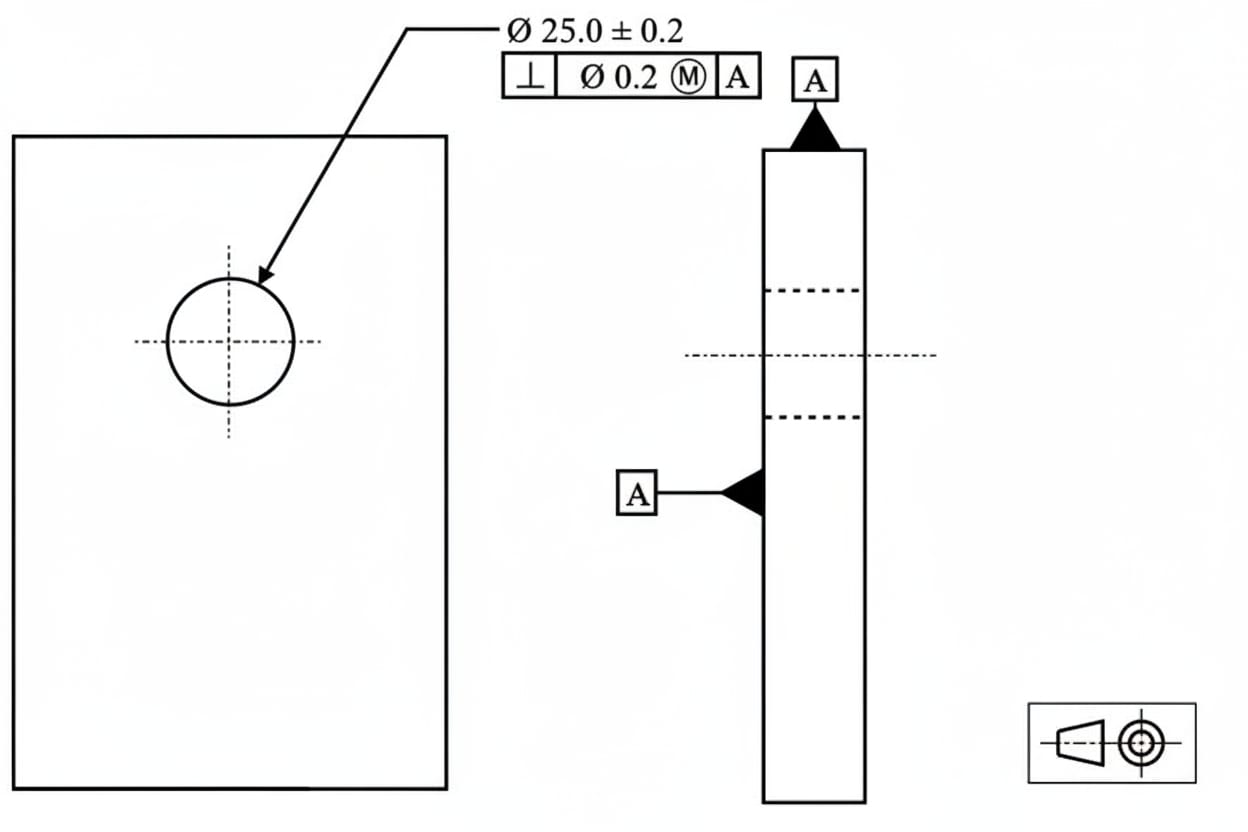
Material Condition Modifiers
What are Material Condition Modifiers?
Material condition modifiers define how geometric tolerance relates to the actual size of a feature. They can provide "bonus tolerance" that increases the allowable variation as a feature departs from its maximum or minimum material condition.The three modifiers are:
| Symbol | Name | Meaning |
|---|---|---|
| Ⓜ or (M) | Maximum Material Condition | Bonus as feature departs from MMC |
| Ⓛ or (L) | Least Material Condition | Bonus as feature departs from LMC |
| Ⓢ or (S) | Regardless of Feature Size | No bonus (RFS is default) |
Understanding Material Conditions
For a Hole (Internal Feature)
- MMC = Smallest hole (most material remaining)
- LMC = Largest hole (least material remaining)
┌─────┐ ┌─────┐ ┌─────┐
│ ○ │ │ ○ │ │ ○ │
│small│ │ nom │ │large│
└─────┘ └─────┘ └─────┘
MMC Nominal LMC
For a Shaft (External Feature)
- MMC = Largest shaft (most material)
- LMC = Smallest shaft (least material)
┌─────┐ ┌─────┐ ┌─────┐
│ ███ │ │ ██ │ │ █ │
│large│ │ nom │ │small│
└─────┘ └─────┘ └─────┘
MMC Nominal LMC
MMC (Ⓜ) - Maximum Material Condition

The Concept
MMC provides bonus tolerance when a feature is NOT at its maximum material condition. The logic: if the hole is bigger (or shaft is smaller), there's more clearance for assembly, so position can be relaxed.
Example: Hole with MMC
Hole size: ⌀ 10.0 ± 0.2 (9.8 to 10.2)
Position: ⌀ 0.25 (M)
MMC = 9.8mm (smallest hole)
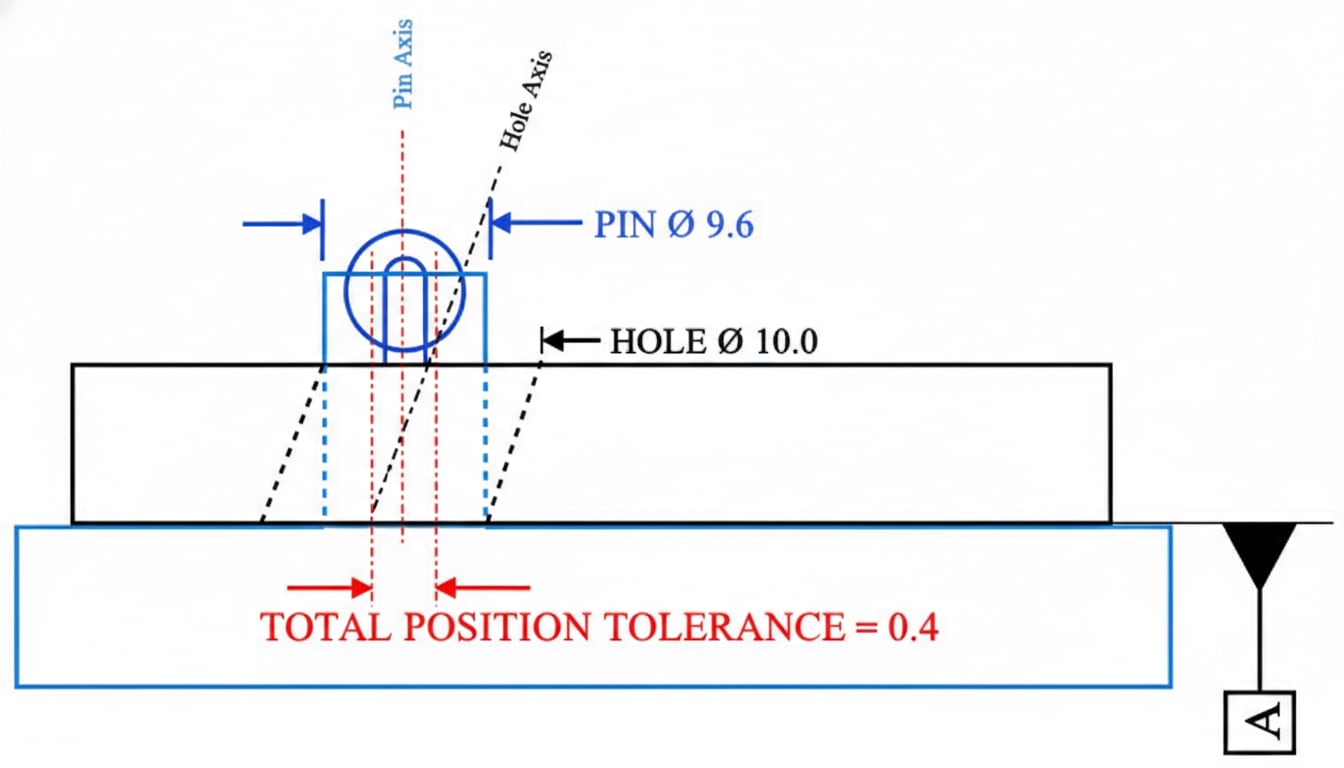
Bonus Tolerance Calculation:
| Actual Hole | Departure from MMC | Bonus | Total Position Tol. |
|---|---|---|---|
| 9.8 (MMC) | 0 | 0 | 0.25 |
| 9.9 | 0.1 | 0.1 | 0.35 |
| 10.0 | 0.2 | 0.2 | 0.45 |
| 10.1 | 0.3 | 0.3 | 0.55 |
| 10.2 (LMC) | 0.4 | 0.4 | 0.65 |
Total Tolerance = Stated Tolerance + (Actual Size - MMC Size)


LMC (Ⓛ) - Least Material Condition
The Concept
LMC provides bonus tolerance as a feature approaches maximum material. Used when minimum wall thickness or edge distance is critical.
Example: Hole Near an Edge
Hole size: ⌀ 10.0 ± 0.2 (9.8 to 10.2)
Position: ⌀ 0.30 (L)
LMC = 10.2mm (largest hole)
Bonus Tolerance Calculation:
| Actual Hole | Departure from LMC | Bonus | Total Position Tol. |
|---|---|---|---|
| 10.2 (LMC) | 0 | 0 | 0.30 |
| 10.1 | 0.1 | 0.1 | 0.40 |
| 10.0 | 0.2 | 0.2 | 0.50 |
| 9.9 | 0.3 | 0.3 | 0.60 |
| 9.8 (MMC) | 0.4 | 0.4 | 0.70 |
- Maintaining minimum wall thickness
- Ensuring minimum edge distance
- Thread engagement requirements
RFS (Ⓢ) - Regardless of Feature Size
The Concept
RFS means the tolerance applies at any size—no bonus tolerance is available. This is the default condition when no modifier is specified.
┌───┬────────┬────────┐ ┌───┬──────────┬────────┐
│ ⊕ │ 0.25 │ A │ = │ ⊕ │ 0.25 (S) │ A │
└───┴────────┴────────┘ └───┴──────────┴────────┘
(implied RFS) (explicit RFS)
Use Cases:
- Critical interfaces where bonus cannot be allowed
- Precision alignment features
- Non-mating features
MMC Modifier on Datums
The modifier can also apply to datum references:
┌───┬────────────┬──────────┐
│ ⊕ │ ⌀ 0.25 (M) │ A (M) │
└───┴────────────┴──────────┘
Datum shift: When datum feature B departs from MMC, the part can shift within the functional gage, providing additional tolerance.
Virtual Condition
For MMC:
- External feature VC = MMC + Geometric Tolerance
- Internal feature VC = MMC - Geometric Tolerance
Example: Pin
Size: ⌀ 10.0 ± 0.1 (MMC = 10.1)
Position: ⌀ 0.2 (M)
Virtual Condition = 10.1 + 0.2 = ⌀ 10.3
For LMC:
- External feature VC = LMC - Geometric Tolerance
- Internal feature VC = LMC + Geometric Tolerance
When to Use Each Modifier
| Modifier | Use When |
|---|---|
| MMC (M) | Assembly fit is the primary concern |
| LMC (L) | Minimum material (wall thickness, edge distance) is critical |
| RFS (S) | Precise alignment required regardless of size |
Modifiers Allowed by Control Type
| Control | MMC/LMC Allowed? |
|---|---|
| Form controls | No (no feature of size) |
| Orientation | Yes (on features of size) |
| Position | Yes (most common) |
| Profile | Yes (2018 standard) |
| Runout | No (must be RFS) |
Key Takeaways
- MMC = Maximum Material Condition (smallest hole, largest shaft)
- LMC = Least Material Condition (largest hole, smallest shaft)
- RFS = Regardless of Feature Size (default, no bonus)
- Bonus tolerance = actual departure from MMC or LMC
- MMC is most common—used for assembly fits
- LMC is used for minimum wall/edge requirements
- Virtual condition defines worst-case boundary
---
Next Lesson: Quiz - Test your GD&T knowledge!