Materials & Steel Grades
Modern BIWs use a carefully engineered mix of materials—each chosen for specific performance requirements. This lesson covers the steel grades that make up 60-80% of most vehicles.
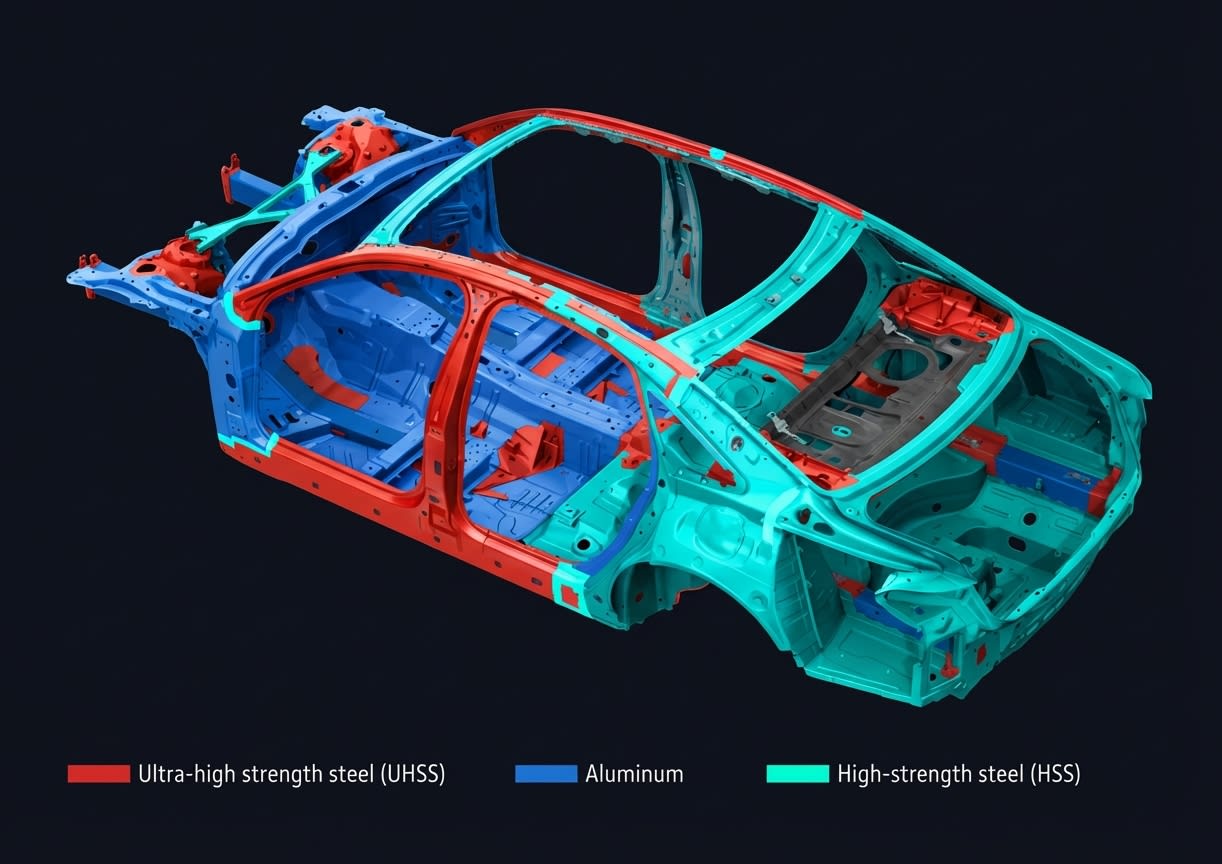
Steel Classification Overview
Automotive steels are classified by yield strength:
| Category | Yield Strength | Examples |
|---|
| Mild Steel | < 210 MPa | Outer panels, non-structural |
| HSS (High-Strength) | 210-550 MPa | Floor pans, some reinforcements |
| AHSS (Advanced High-Strength) | 550-1000 MPa | Rails, structural members |
| UHSS (Ultra-High-Strength) | > 1000 MPa | B-pillars, safety cage |
Mild Steel
Mild steel (also called low-carbon steel) is the traditional automotive material:
| Property | Value |
|---|
| Yield Strength | 140-210 MPa |
| Formability | Excellent |
| Weldability | Excellent |
| Cost | Lowest |
Where Mild Steel is Used
- Outer body panels — doors, hood, fenders, roof
- Non-structural brackets
- Areas requiring deep draws
Mild steel is easy to stamp into complex shapes but provides minimal crash protection.
Sponsored
April batch closing soon — only 42 seats remaining
Join 3,000+ engineers who got placed at top companies
High-Strength Steel (HSS)
HSS offers improved strength while maintaining reasonable formability:
| Property | Value |
|---|
| Yield Strength | 210-550 MPa |
| Formability | Good |
| Weldability | Good |
| Weight Savings | 10-20% vs. mild steel |
HSS Types
| Type | Mechanism | Typical Use |
|---|
| HSLA (High-Strength Low-Alloy) | Microalloying | Floor pans, inner panels |
| BH (Bake Hardening) | Strengthens during paint cure | Outer panels |
| IF-HS (Interstitial-Free) | Ultra-low carbon | Deep-draw parts |
Advanced High-Strength Steel (AHSS)
AHSS represents the first generation of advanced steels with strength + formability:
| Property | Value |
|---|
| Yield Strength | 550-1000 MPa |
| Formability | Moderate |
| Weldability | Moderate |
| Weight Savings | 20-35% vs. mild steel |
AHSS Types (1st Generation)
| Type | Characteristics | Typical Use |
|---|
| DP (Dual Phase) | Hard martensite + soft ferrite | Front rails, side members |
| TRIP (Transformation-Induced Plasticity) | High energy absorption | Crash structures |
| CP (Complex Phase) | Fine-grain microstructure | Bumper beams |
| FB (Ferritic-Bainitic) | Good stretch flangeability | Chassis parts |
AHSS Types (2nd & 3rd Generation)
| Type | Characteristics | Typical Use |
|---|
| Q&P (Quench & Partition) | Retained austenite + martensite | Advanced crash structures |
| TBF (TRIP-Bainitic Ferrite) | High formability + strength | Complex structural parts |
| Medium-Mn | 5-10% manganese | Next-gen lightweighting |
Ultra-High-Strength Steel (UHSS)
UHSS provides maximum strength for critical safety components:
| Property | Value |
|---|
| Yield Strength | 1000-2000 MPa |
| Formability | Limited (requires hot stamping) |
| Weldability | Requires special processes |
| Weight Savings | 35-50% vs. mild steel |
Hot Stamping (Press Hardening)
Most UHSS parts are made via hot stamping:
Hot Stamping Process:
┌─────────────────────────────────────────────────┐
│                                                 │
│  1. Heat blank to 900°C+ (austenite phase)     │
│            ↓                                    │
│  2. Transfer to cooled die (< 10 sec)          │
│            ↓                                    │
│  3. Form and quench simultaneously             │
│            ↓                                    │
│  4. Part hardens to martensite (1500+ MPa)     │
│                                                 │
└─────────────────────────────────────────────────┘
Hot-Stamped Components
| Component | Typical Strength |
|---|
| B-pillar reinforcement | 1500-2000 MPa |
| A-pillar reinforcement | 1500 MPa |
| Roof rail reinforcement | 1200-1500 MPa |
| Rocker reinforcement | 1500 MPa |
| Bumper beams | 1500 MPa |
Boron Steel (22MnB5)
The most common hot-stamping steel is 22MnB5:
- 22 — 0.22% carbon
- Mn — manganese alloyed
- B5 — boron microalloyed
- Pre-heat strength: ~600 MPa
- Post-quench strength: 1500 MPa
Tailor-Welded Blanks (TWB)
Tailor-welded blanks join different steel grades/thicknesses before stamping:
Tailor-Welded B-Pillar Blank:
┌──────────┬──────────┬──────────┐
│ 1.0mm    │ 1.8mm    │ 1.2mm    │
│ PHS1500  │ PHS1500  │ PHS1000  │
│ (roof    │ (impact  │ (lower   │
│  area)   │  zone)   │  attach) │
└──────────┴──────────┴──────────┘
        Laser welds
Benefits:
Sponsored
3,000+ engineers placed at Mahindra, Bosch, TATA ELXSI
Including Continental, Capgemini, Ola Electric & 500+ more companies
- Optimized strength where needed
- Weight savings in low-stress areas
- Reduced part count — one stamping vs. multiple
Tailor-Rolled Blanks (TRB)
Tailor-rolled blanks vary thickness continuously (no welds):
Tailor-Rolled Blank:
┌─────────────────────────────────┐
│ 1.0mm → 1.5mm → 2.0mm → 1.5mm  │
│         Continuous roll         │
└─────────────────────────────────┘
Advantages over TWB:
- No weld seams (potential weak points)
- Smoother thickness transitions
- Better fatigue performance
Aluminum in BIW
While this course focuses on steel, aluminum is increasingly used:
| Aluminum Use | Benefits | Challenges |
|---|
| Hood | 50% weight savings | Higher cost |
| Fenders | Dent resistance | Joining to steel |
| Front rails | Crash absorption | Galvanic corrosion |
| Space frames | Overall lightweighting | Tooling investment |
Aluminum vs. Steel
| Property | Aluminum | Steel |
|---|
| Density | 2.7 g/cm³ | 7.8 g/cm³ |
| Modulus | 70 GPa | 210 GPa |
| Cost | 3-4x steel | Baseline |
| Recyclability | Excellent | Excellent |
Material Selection by Zone
Modern BIWs use a zone-based approach:
Sponsored
Gaurav Jadhav is now a CAE Engineer
Practical projects and mock interviews made the difference
| Zone | Priority | Typical Materials |
|---|
| Safety Cage | Maximum strength | UHSS, hot-stamped |
| Crash Rails | Energy absorption | AHSS (DP, TRIP) |
| Floor Structure | Stiffness, cost | HSS, AHSS |
| Outer Panels | Formability, surface | Mild steel, aluminum |
| Closures | Weight, dent resistance | Aluminum, mild steel |
Key Takeaways
- Steel grades range from mild (< 210 MPa) to UHSS (> 1000 MPa)
- AHSS (DP, TRIP, CP) balances strength and formability
- UHSS requires hot stamping for forming
- 22MnB5 boron steel reaches 1500 MPa after quenching
- Tailor-welded/rolled blanks optimize thickness distribution
- Zone-based approach: strongest materials in safety cage, energy-absorbing materials in crush zones
---
Next Lesson: Joining Methods — how all these different materials are connected.