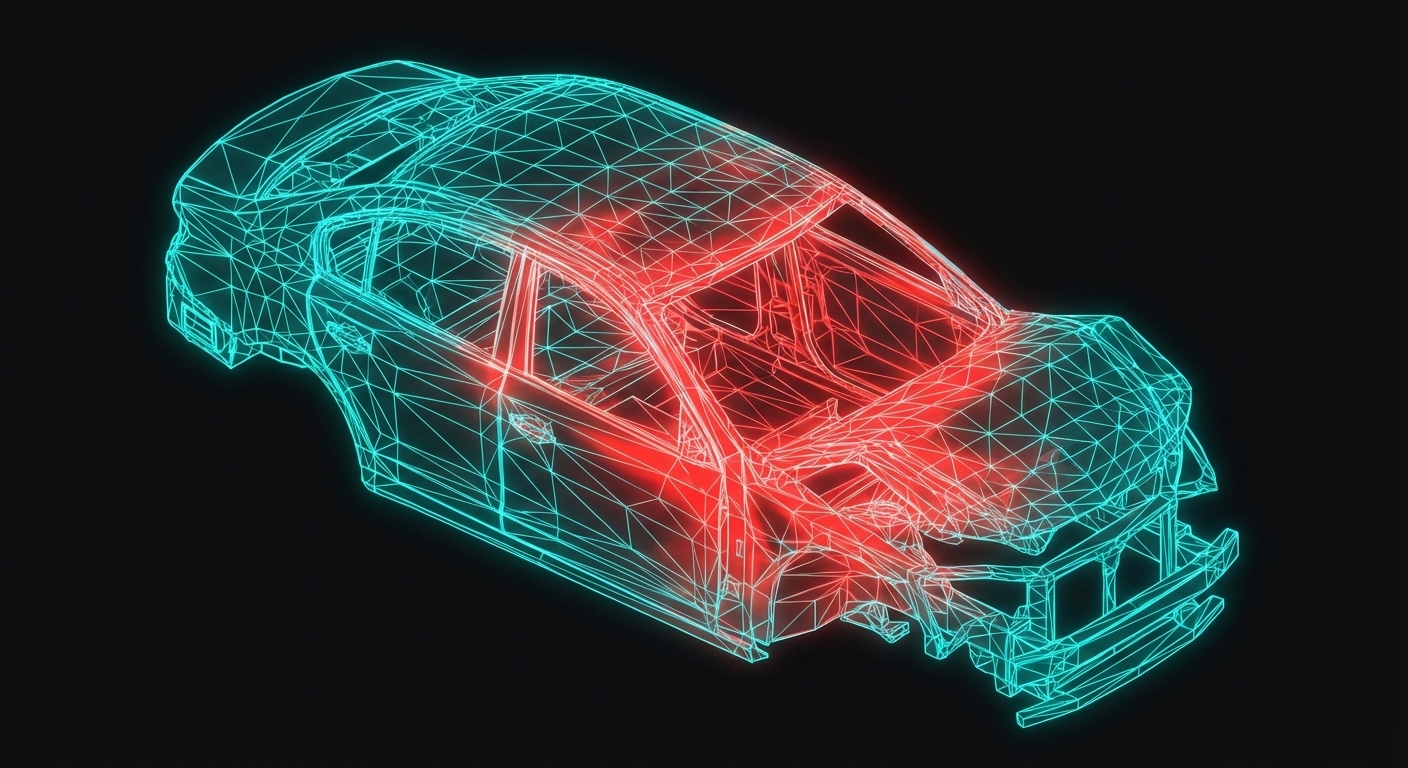
In linear FEA, we assume small strains — the geometry barely changes. But in crash simulation, rubber seal analysis, and metal forming, deformations can exceed 50% strain. This requires large deformation kinematics — the mathematical framework for tracking material through significant shape changes.
Reference vs Current Configuration
The key insight of large deformation mechanics is distinguishing between two configurations:
Reference Configuration $\Omega_0$: The undeformed state. Material points are labeled by their positions $\mathbf{X}$.
Current Configuration $\Omega_t$: The deformed state at time $t$. The same material points now occupy positions $\mathbf{x}$.
Drag the control points to deform the body. Watch how material points move from reference to current configuration.
The Deformation Mapping
The relationship between reference and current positions is the deformation mapping:
This function tells us: "Given a material point originally at position $\mathbf{X}$, where is it located at time $t$?"
Example: Rubber Seal Compression
A door seal cross-section deforms when the door closes. A simple deformation mapping might be:
Sponsored
Abhishek landed his dream job at TATA ELXSI
From learning simulations to working at an industry leader
See His Journey
$$\varphi_1 = (1 - 0.3t) X_1 + t(X_2 - h)^2$$
$$\varphi_2 = (1 + 0.2t) X_2$$
This captures:
Sponsored
Master CATIA, NX, LS-DYNA, HyperMesh, ANSYS
The exact tools used by Mahindra, Bosch & TATA ELXSI
See All Tools
Compression in $X_1$ direction (factor decreases with time)
Extension in $X_2$ direction (factor increases with time)
Nonlinear shear (quadratic term creates bulging)
🎯3,000+ Engineers Placed
Sponsored
Harshal
Fiat Chrysler
Abhishek
TATA ELXSI
Srinithin
Xitadel
Ranjith
Core Automotive
Gaurav
Automotive Company
Bino
Design Firm
Aseem
EV Company
Puneet
Automotive Company
Vishal
EV Startup
More Success Stories
Material Point Tracking
In the animation below, we track a specific material point through deformation:
Reference position: $\mathbf{X} = (X_1, X_2)$ — where the point starts
Current position: $\mathbf{x} = \boldsymbol{\varphi}(\mathbf{X}, t)$ — where it moves to
Displacement: $\mathbf{u} = \mathbf{x} - \mathbf{X}$ — how far it moved
The Python code for tracking a material point:
def phi(X, t):
    """Deformation mapping for rubber seal compression."""
    x0 = (1 - 0.25*t) * X[0] + t * (X[1] - 2)**2 + 2.5*t
    x1 = (1 + 0.25*t) * X[1] + 0.25*t
    x2 = X[2]
    return (x0, x1, x2)

# Track a material point
X = np.array([0.75, 1.25, 0.0])  # Reference position

for t in np.linspace(0, 1, 50):
    x = phi(X, t)  # Current position at time t
    u = x - X      # Displacement
    print(f"t={t:.2f}: x={x}, displacement={u}")
Automotive Applications
Crash Simulation
In LS-DYNA crash analysis, every element tracks its nodes through massive deformation:
Frontal crash: Hood crumples from 1m to 0.3m (70% compression)
Pole impact: B-pillar bends inward, material stretches and compresses
The element formulation must handle this without locking or hourglassing.
Rubber Seals
Door seals, engine mounts, and bushings undergo cyclic large deformations:
Compression set: Does the seal return to original shape?
Stress-strain response: Nonlinear, path-dependent
Visualizing kinematics helps engineers understand local deformation patterns.
This should change shape (no stretching, no volume change).
Key Takeaways
Reference configuration $\Omega_0$ is the undeformed state; current configuration $\Omega_t$ is deformed
Deformation mapping $\mathbf{x} = \boldsymbol{\varphi}(\mathbf{X}, t)$ tracks where material points go
Displacement $\mathbf{u} = \mathbf{x} - \mathbf{X}$ measures how far points move
Valid deformations must be invertible ($\det\mathbf{F} > 0$)
Visualizing kinematics builds intuition for crash, rubber, and forming simulations
What's Next
In the next lesson, we'll examine the deformation gradient tensor $\mathbf{F}$ — the key quantity that describes local stretching and rotation at every material point.
Career Growth
3,000+ Engineers Placed in Top Companies
Join the ranks of successful engineers at Bosch, Tata, L&T, and 500+ hiring partners.