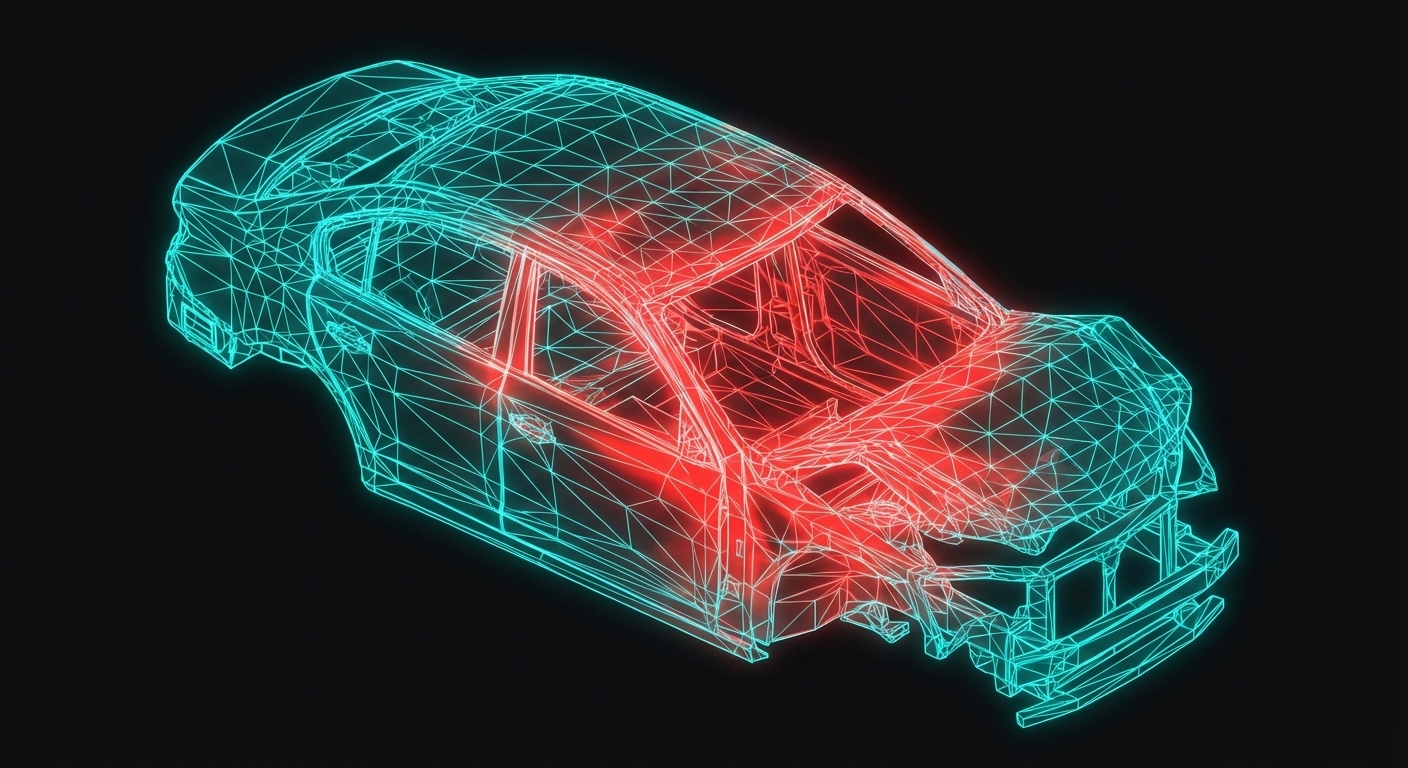
When you look at stress results in ANSYS or LS-DYNA, you see six components: $\sigma_{11}$, $\sigma_{22}$, $\sigma_{33}$, $\sigma_{12}$, $\sigma_{23}$, $\sigma_{13}$. But what do these numbers actually mean physically?
In this lesson, we'll visualize each component as traction vectors acting on the surfaces of an infinitesimal volume element. This physical interpretation is essential for understanding FEA results and identifying failure modes.
The Cauchy Stress Tensor
At every point in a solid, internal forces act between material particles. These forces are described by the Cauchy stress tensor:
Sponsored
Abhishek landed his dream job at TATA ELXSI
From learning simulations to working at an industry leader
Due to moment equilibrium (no angular acceleration), the stress tensor is symmetric: $\sigma_{ij} = \sigma_{ji}$. This means we have 6 independent components, not 9.
Component Interpretation
Diagonal terms ($\sigma_{11}, \sigma_{22}, \sigma_{33}$): Normal stresses — force perpendicular to the face
Off-diagonal terms ($\sigma_{12}, \sigma_{23}, \sigma_{13}$): Shear stresses — force parallel to the face
The subscripts indicate:
Sponsored
April batch closing soon — only 42 seats remaining
Join 3,000+ engineers who got placed at top companies
Reserve Your Seat
First index: Direction of the face normal
Second index: Direction of the force
For example, $\sigma_{12}$ acts on a face with normal in the 1-direction (x-face), and the force is in the 2-direction (y-direction).
Click to toggle between stress components. Observe how traction vectors change direction.
Cauchy's Formula: From Stress to Traction
Given a surface with outward unit normal $\mathbf{n}$, the traction vector (force per unit area) is:
What do the traction vectors look like? (They should all point inward, perpendicular to each face.)
Exercise 2: Pure Shear
Set $\sigma_{12} = \sigma_{21} = \tau$ and all other components to zero. Visualize how shear stress creates traction parallel to face surfaces.
Exercise 3: Uniaxial Tension
Set $\sigma_{11} = \sigma_0$ and all other components to zero. This represents a tensile test specimen. What happens on oblique planes?
Key Takeaways
The Cauchy stress tensor has 6 independent components due to symmetry
Cauchy's formula $\mathbf{t} = \boldsymbol{\sigma} \cdot \mathbf{n}$ gives traction from stress and normal
Diagonal components are normal stresses; off-diagonal are shear stresses
Visualizing stress on cube or sphere surfaces builds physical intuition
Von Mises stress combines all components into a scalar for yield/fatigue criteria
What's Next
In the next lesson, we'll explore large deformation kinematics — how bodies move and deform in nonlinear analysis. You'll learn to animate reference and current configurations, and track material points through deformation.
Career Growth
3,000+ Engineers Placed in Top Companies
Join the ranks of successful engineers at Bosch, Tata, L&T, and 500+ hiring partners.