

Automotive Engineering Interview Questions
Vehicle systems, powertrains, chassis, EV technology, and automotive testing
1 Explain the working of a MacPherson strut suspension.
Easy
Explain the working of a MacPherson strut suspension.
A MacPherson strut combines the shock absorber and coil spring into a single unit that also serves as the upper steering pivot. The strut assembly connects to the wheel hub at the bottom and the vehicle body at the top, providing compact packaging and cost-effective suspension for front-wheel-drive vehicles. It allows vertical wheel travel while maintaining camber and providing damping.
2 What is the difference between monocoque and body-on-frame construction?
Easy
What is the difference between monocoque and body-on-frame construction?
Monocoque (unibody) construction integrates the body and frame into a single welded structure, offering lighter weight, better crash energy absorption, and improved fuel efficiency - common in passenger cars. Body-on-frame uses a separate ladder frame onto which the body is mounted, providing higher load-carrying capacity and easier repair, making it preferred for trucks and SUVs like the Toyota Fortuner or Mahindra Thar.
3 Describe the four strokes of a petrol engine.
Easy
Describe the four strokes of a petrol engine.
The four strokes are: Intake (piston moves down, intake valve opens, air-fuel mixture enters cylinder), Compression (piston moves up, both valves closed, mixture is compressed), Power (spark plug ignites mixture, expanding gases push piston down), and Exhaust (piston moves up, exhaust valve opens, burnt gases expelled). This completes two crankshaft revolutions per cycle.
4 What are the advantages of disc brakes over drum brakes?
Easy
What are the advantages of disc brakes over drum brakes?
Disc brakes offer better heat dissipation due to their exposed design, resulting in reduced brake fade during repeated braking. They are self-cleaning as centrifugal force throws off water and debris, provide more consistent braking force, and are easier to inspect and service. However, drum brakes are more cost-effective and better suited for parking brake integration, which is why many vehicles use discs in front and drums in rear.
5 How does a turbocharger increase engine power?
Easy
How does a turbocharger increase engine power?
A turbocharger uses exhaust gas energy to spin a turbine connected to a compressor via a common shaft. The compressor forces more air into the engine cylinders, allowing more fuel to be burned and producing more power from the same displacement. This results in better power-to-weight ratio and improved efficiency. Intercoolers are often used to cool the compressed air, increasing density and preventing knock.
Get IIT Jammu PG Certification
Master these concepts with 175+ hours of industry projects and hands-on training.
6 What are the main components of an electric vehicle powertrain?
Easy
What are the main components of an electric vehicle powertrain?
The main EV powertrain components are: Battery pack (stores electrical energy, typically lithium-ion), Electric motor (converts electrical to mechanical energy, usually PMSM or induction type), Inverter (converts DC from battery to AC for motor), Onboard charger (converts AC from grid to DC for battery charging), Battery Management System (monitors cell health, temperature, and state of charge), and Thermal management system (maintains optimal operating temperatures).
7 What is the purpose of crumple zones in vehicle design?
Easy
What is the purpose of crumple zones in vehicle design?
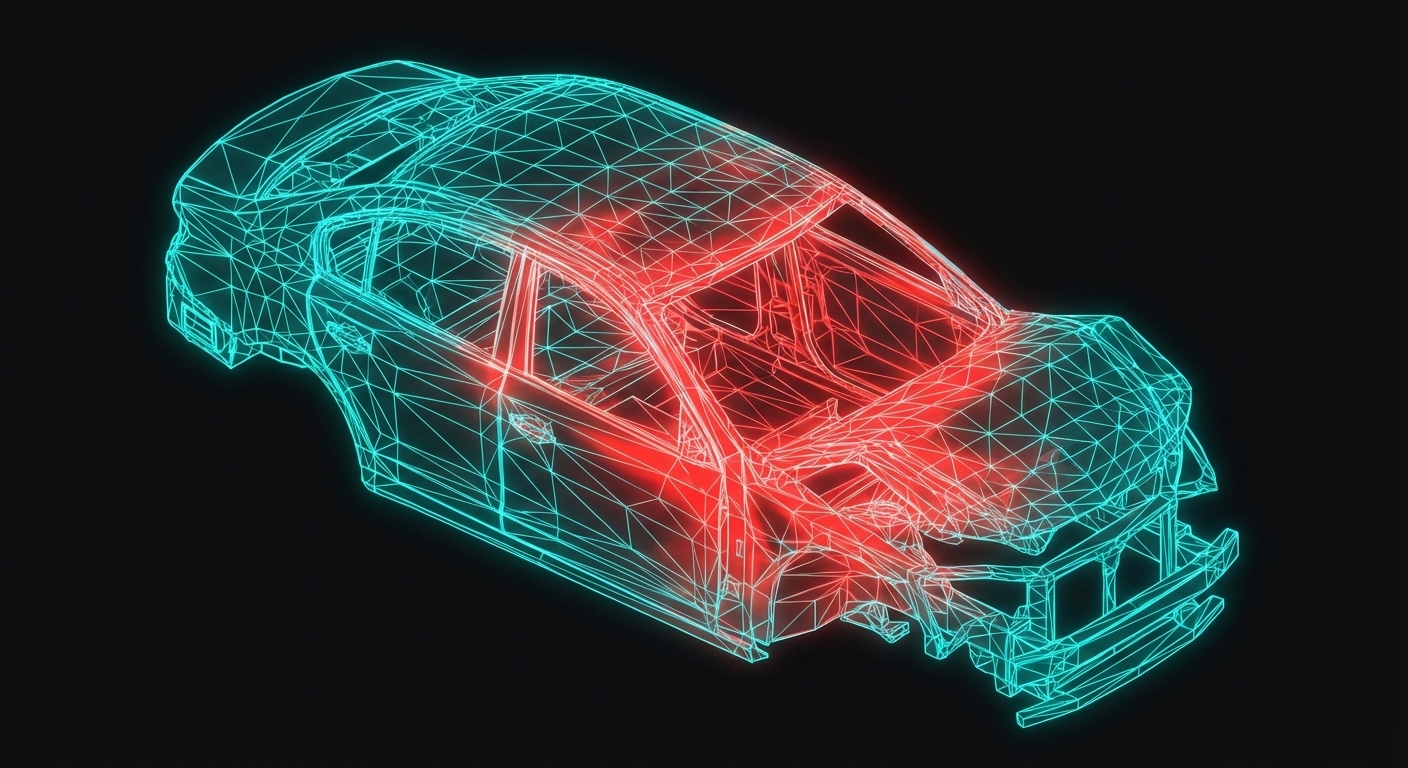
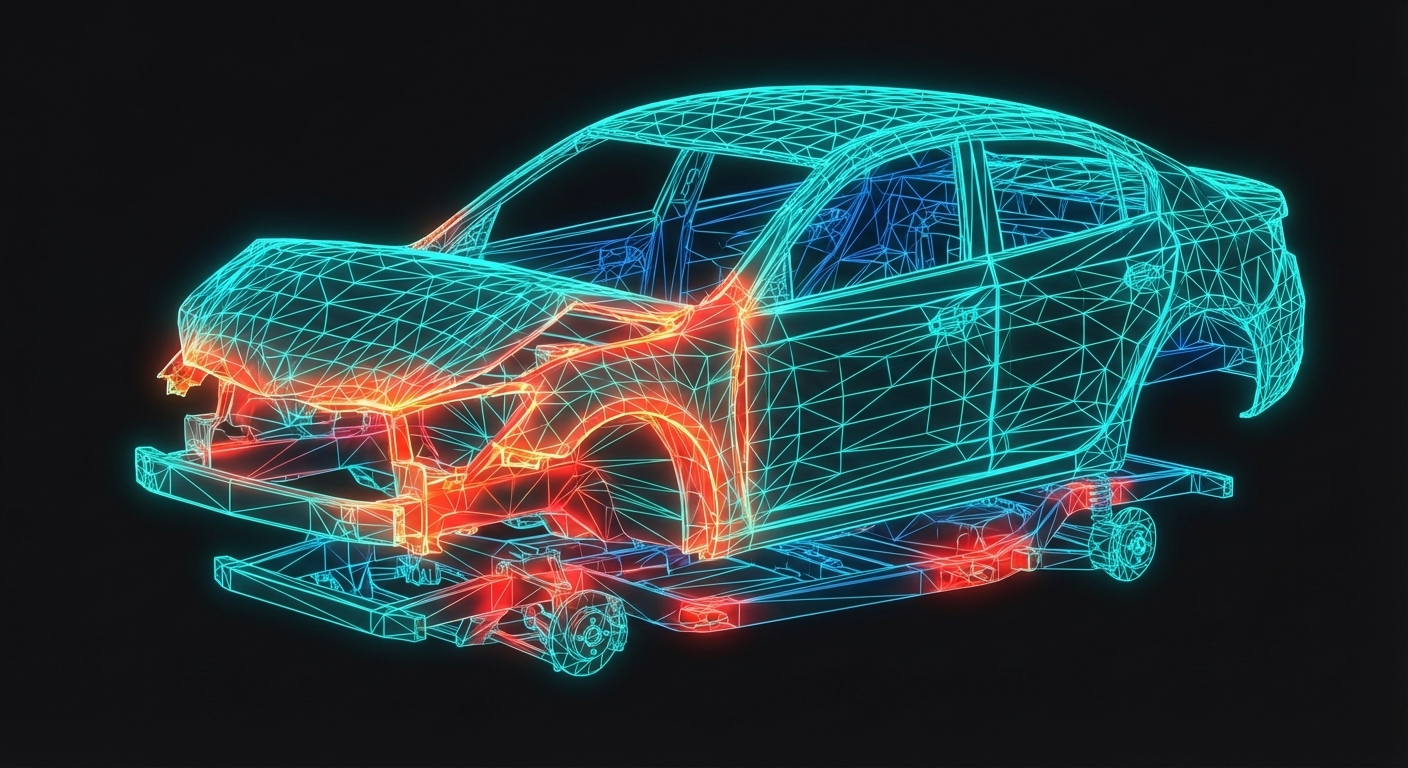
Crumple zones are engineered areas at the front and rear of vehicles designed to deform progressively during a collision, absorbing crash energy and extending the deceleration time. This reduces the peak forces transmitted to the passenger cabin, protecting occupants. The controlled deformation converts kinetic energy into deformation work while the rigid passenger cell maintains survival space.
8 How does Anti-lock Braking System (ABS) work?
Easy
How does Anti-lock Braking System (ABS) work?
ABS uses wheel speed sensors to detect when a wheel is about to lock during braking. When impending lock is detected, the hydraulic control unit rapidly modulates brake pressure (typically 15-20 times per second) to that wheel, releasing and reapplying pressure to maintain optimal slip ratio (10-20%). This prevents wheel lockup, maintains steering control, and often reduces stopping distance on slippery surfaces.
9 What is the function of a differential in a vehicle?
Easy
What is the function of a differential in a vehicle?
A differential allows the driven wheels to rotate at different speeds while transmitting power from the driveshaft. This is essential during cornering when the outer wheel must travel a longer distance than the inner wheel. Without a differential, the inside wheel would scrub during turns, causing tire wear, poor handling, and drivetrain stress. Open, limited-slip, and locking differentials offer varying traction characteristics.
10 What is regenerative braking and how does it work in EVs?
Easy
What is regenerative braking and how does it work in EVs?
Regenerative braking converts the vehicle's kinetic energy back into electrical energy during deceleration. When the driver lifts off the accelerator or applies brakes, the electric motor operates as a generator, creating resistance that slows the vehicle while charging the battery. This can recover 10-30% of energy depending on driving conditions and significantly extends EV range, especially in city driving with frequent stops.
11 What is the function of a catalytic converter?
Easy
What is the function of a catalytic converter?
A catalytic converter reduces harmful exhaust emissions by promoting chemical reactions that convert pollutants into less harmful substances. Three-way catalytic converters use precious metal catalysts (platinum, palladium, rhodium) to simultaneously oxidize carbon monoxide and unburnt hydrocarbons into CO2 and water, while reducing nitrogen oxides into nitrogen and oxygen. They require operating temperatures of 400-800°C for optimal efficiency.
12 What does NVH stand for and why is it important in automotive design?
Easy
What does NVH stand for and why is it important in automotive design?
NVH stands for Noise, Vibration, and Harshness. Noise refers to audible sounds (engine, wind, road noise), vibration refers to tactile oscillations felt through steering, seats, and pedals, and harshness describes the vehicle's response to impacts like potholes. NVH is crucial for customer comfort, perceived quality, and brand differentiation. Engineers use isolation mounts, damping materials, and structural optimization to minimize NVH.
13 What are the handling differences between FWD and RWD vehicles?
Easy
What are the handling differences between FWD and RWD vehicles?
FWD vehicles tend toward understeer (front wheels lose grip first during cornering) because the front tires handle both steering and driving forces. They offer better traction in slippery conditions due to weight over driven wheels and are more space-efficient. RWD vehicles provide better weight distribution, more neutral handling, and can exhibit oversteer. RWD is preferred for performance cars as it separates steering and driving functions between axles.
14 What is common rail direct injection (CRDi) in diesel engines?
Easy
What is common rail direct injection (CRDi) in diesel engines?
Common rail direct injection uses a high-pressure fuel rail (1600-2500 bar) that supplies all injectors, unlike older systems where each injector had its own pump. This allows precise electronic control of injection timing, pressure, and multiple injection events per cycle. Benefits include reduced noise, lower emissions, better fuel economy, and improved power delivery. It's standard in modern diesel vehicles like Mahindra Scorpio and Hyundai Creta diesel variants.
15 How do airbags work during a collision?
Easy
How do airbags work during a collision?
Airbags deploy when crash sensors detect rapid deceleration exceeding a threshold (typically 15-30g). The sensors send a signal to the airbag control unit, which triggers an igniter that burns a solid propellant (usually sodium azide), producing nitrogen gas that inflates the airbag in 25-50 milliseconds. The bag then deflates through vent holes as the occupant contacts it, absorbing energy gradually and reducing head and chest injury severity.
3,000+ Engineers Placed at Top Companies
Join Bosch, Tata Motors, L&T, Mahindra and 500+ hiring partners.
16 What are the different thermal management strategies for EV batteries?
Medium
What are the different thermal management strategies for EV batteries?
EV battery thermal management strategies include: Air cooling (simple but limited capacity, used in low-power applications), Liquid cooling (glycol-water mixture circulating through cooling plates, most common in modern EVs like Tata Nexon EV), Refrigerant direct cooling (more efficient but complex), and Phase change materials (passive, for temperature buffering). Optimal battery temperature is 20-40°C; outside this range, performance, efficiency, and lifespan degrade significantly.
17 Why is double wishbone suspension preferred for performance vehicles?
Medium
Why is double wishbone suspension preferred for performance vehicles?
Double wishbone suspension offers superior camber control throughout the suspension travel, maintaining optimal tire contact with the road during cornering. The upper and lower control arms allow independent adjustment of camber, caster, toe, and anti-dive/anti-squat geometry. This results in better handling, more consistent tire wear, and improved ride quality. However, it requires more space and is more expensive than MacPherson struts, limiting its use to premium vehicles.
18 Explain Variable Valve Timing (VVT) and its benefits.
Medium
Explain Variable Valve Timing (VVT) and its benefits.
VVT adjusts the timing of intake and/or exhaust valve opening relative to crankshaft position based on engine speed and load. At low RPM, valve overlap is minimized for smooth idle; at high RPM, overlap increases for better volumetric efficiency. Methods include cam phasers (hydraulic or electric), cam profile switching (like Honda's VTEC), and fully variable systems. Benefits include improved power across the RPM range, better fuel economy, and reduced emissions.
19 How can understeer and oversteer be tuned through chassis setup?
Medium
How can understeer and oversteer be tuned through chassis setup?
Understeer can be reduced by: softening front springs/anti-roll bar, stiffening rear, increasing front tire grip, or moving weight rearward. Oversteer can be reduced by opposite changes: stiffening front, softening rear, or reducing rear tire grip. Suspension geometry (roll center height, toe settings), differential type, and weight distribution also affect balance. Engineers target slight understeer for safety as it's more predictable for average drivers.
20 Compare Permanent Magnet Synchronous Motors (PMSM) and Induction Motors for EVs.
Medium
Compare Permanent Magnet Synchronous Motors (PMSM) and Induction Motors for EVs.
PMSM offers higher efficiency (especially at partial load), higher power density, and lower heat generation, making it preferred for most EVs (Tata, Mahindra, Hyundai EVs). However, it requires expensive rare-earth magnets and has efficiency drop at high speeds. Induction motors are more robust, lower cost, and better at high-speed operation (Tesla Model S rear motor), but less efficient at typical driving conditions. Many modern EVs use PMSM for primary drive and induction for secondary.
21 What are the main crash tests conducted under Bharat NCAP?
Medium
What are the main crash tests conducted under Bharat NCAP?
Bharat NCAP includes: Frontal Offset Deformable Barrier test (64 km/h, 40% overlap, simulating head-on collision), Side Impact Barrier test (50 km/h, moving deformable barrier), and Side Pole Impact test (optional, 29 km/h into rigid pole). Tests evaluate adult occupant protection (16 points max), child occupant protection (49 points max), and safety assist technologies. Ratings range from 0-5 stars, with most Indian manufacturers now targeting 4-5 star ratings.
22 What are the advantages of Electric Power Steering (EPS) over hydraulic steering?
Medium
What are the advantages of Electric Power Steering (EPS) over hydraulic steering?
EPS advantages include: Better fuel efficiency (no parasitic pump load, 3-5% improvement), variable assist tuning through software, easier integration with ADAS features (lane keeping, parking assist), reduced weight and complexity (no pump, hoses, fluid), lower maintenance, and packaging flexibility. EPS can provide speed-sensitive assist and simulate road feel. Modern vehicles almost exclusively use EPS, with hydraulic retained only in heavy commercial vehicles.
23 What methods are used to isolate engine vibrations from the cabin?
Medium
What methods are used to isolate engine vibrations from the cabin?
Engine vibration isolation methods include: Rubber engine mounts (tuned for specific frequency ranges), hydraulic mounts (better damping at varying frequencies), active engine mounts (electronically controlled for optimal isolation), structural damping treatments (constrained layer damping), decoupled subframes, and powertrain balancing (balance shafts in 4-cylinder engines). Modern EVs face different challenges as motor vibrations are minimal, but high-frequency whine requires different solutions.
24 What materials are used in modern BIW construction and why?
Medium
What materials are used in modern BIW construction and why?
Modern BIW uses a multi-material approach: Mild steel (cost-effective for less critical areas), High Strength Steel/AHSS (900-1500 MPa for crash-critical members like B-pillar), Ultra High Strength Steel (hot-stamped, >1500 MPa for intrusion prevention), Aluminum (closures, subframes for weight reduction), Magnesium (instrument panel beam), and Carbon Fiber Reinforced Plastic (premium vehicles). Material selection balances strength, weight, cost, formability, joinability, and repairability.
25 How does a Dual Clutch Transmission (DCT) work?
Medium
How does a Dual Clutch Transmission (DCT) work?
DCT uses two separate clutches - one for odd gears (1,3,5,7) and one for even gears (2,4,6). While driving in one gear, the next gear is pre-selected on the other shaft. During upshift, one clutch disengages while the other engages simultaneously, providing near-seamless power delivery with shift times under 100ms. This combines automatic convenience with manual efficiency. However, DCTs can be jerky at low speeds and complex/expensive to repair.

Harshal
Fiat Chrysler

Abhishek
TATA ELXSI

Srinithin
Xitadel

Ranjith
Core Automotive

Gaurav
Automotive Company

Bino
Design Firm

Aseem
EV Company

Puneet
Automotive Company

Vishal
EV Startup
More Success Stories
26 Compare LiDAR and Radar sensors for ADAS applications.
Medium
Compare LiDAR and Radar sensors for ADAS applications.
LiDAR creates detailed 3D point clouds with high angular resolution for precise object detection and classification, but is expensive and affected by weather conditions. Radar excels in velocity measurement, works in all weather, is cost-effective, but has lower resolution. Modern ADAS uses sensor fusion: radar for long-range detection and velocity, camera for classification, and optionally LiDAR for precise spatial mapping. Companies like Ola Electric and Tata are integrating multiple sensor modalities.
27 What factors affect the real-world range of an electric vehicle?
Medium
What factors affect the real-world range of an electric vehicle?
EV range is affected by: Driving style (aggressive acceleration reduces range 20-30%), HVAC usage (heating can reduce range 30-40% in cold weather), Ambient temperature (battery efficiency drops below 0°C and above 35°C), Speed (aerodynamic drag increases with square of velocity), Terrain (hills require more energy), Payload, Tire rolling resistance, and Battery degradation (typically 2-3% per year). OEM-stated ARAI range often differs from real-world by 15-25%.
28 Explain the role of a transfer case in AWD/4WD systems.
Medium
Explain the role of a transfer case in AWD/4WD systems.
A transfer case distributes power between front and rear axles in AWD/4WD vehicles. Part-time 4WD systems (like in Mahindra Thar) use a transfer case that can be shifted between 2WD, 4WD High, and 4WD Low. Full-time AWD systems have a center differential in the transfer case for continuous power split. Electronic transfer cases can vary torque distribution (0-100% front/rear) based on traction conditions using clutch packs or electronically controlled differentials.
29 How is spring rate determined for vehicle suspension design?
Medium
How is spring rate determined for vehicle suspension design?
Spring rate selection considers: Vehicle weight distribution (spring rate = corner weight / desired wheel travel), desired ride frequency (typically 1-1.5 Hz for comfort, 1.5-2.5 Hz for sports cars), roll stiffness requirements, available wheel travel, and tire characteristics. Front-to-rear spring rate ratio affects handling balance. Engineers use ride rate (spring rate corrected for motion ratio) and roll rate calculations, validated through K&C (kinematics and compliance) testing.
30 What parameters are measured in automotive wind tunnel testing?
Medium
What parameters are measured in automotive wind tunnel testing?
Wind tunnel testing measures: Drag coefficient (Cd, affects fuel economy and top speed), Lift coefficients (front and rear, affects stability), Side force and yaw moment (crosswind stability), Pressure distribution (using pressure taps), Flow visualization (wool tufts, smoke, oil flow), and Acoustic measurements. A typical sedan has Cd of 0.25-0.35. Engineers optimize using active aero, underbody panels, wheel arch treatments, and mirror design. CFD simulations complement physical testing.
31 What are the key functions of a Battery Management System (BMS)?
Medium
What are the key functions of a Battery Management System (BMS)?
BMS functions include: Cell voltage monitoring (ensuring no cell exceeds safe limits), State of Charge (SoC) estimation (using coulomb counting and voltage methods), State of Health (SoH) monitoring, Temperature monitoring and thermal management control, Cell balancing (passive or active, ensuring uniform cell performance), Current monitoring (preventing overcurrent), Communication with vehicle controller, and Fault detection/diagnostics. BMS protects the battery and optimizes its performance and lifespan.
32 Explain Exhaust Gas Recirculation (EGR) and its types.
Medium
Explain Exhaust Gas Recirculation (EGR) and its types.
EGR reduces NOx emissions by recirculating a portion of exhaust gas back to intake, lowering combustion temperature (NOx formation increases exponentially above 1500°C). High-pressure EGR (HP-EGR) takes gas before the turbo and returns it before the intercooler. Low-pressure EGR (LP-EGR) takes gas after DPF and returns it before the compressor, providing cooler, cleaner gas but with higher pumping losses. Modern diesels use both systems coordinated by ECU.
33 Explain the importance of caster, camber, and toe angles in wheel alignment.
Medium
Explain the importance of caster, camber, and toe angles in wheel alignment.
Caster is the angle of the steering axis from vertical (viewed from side) - positive caster improves straight-line stability and steering returnability. Camber is wheel tilt from vertical (viewed from front) - negative camber improves cornering grip but causes inner edge wear. Toe is the angle between wheel centerline and vehicle centerline (viewed from above) - toe-in improves stability while toe-out improves turn-in response. These angles interact and must be optimized together.
34 Why is torsional stiffness important in vehicle body design?
Medium
Why is torsional stiffness important in vehicle body design?
Torsional stiffness (Nm/degree) determines how much the body twists when subjected to asymmetric loads (like one wheel hitting a bump). Higher stiffness ensures predictable handling by maintaining suspension geometry, prevents door/window seal issues and squeaks/rattles, and provides better NVH characteristics. Modern unibodies target 25,000-40,000 Nm/deg. Convertibles require additional reinforcement due to absence of roof structure. Stiffness is measured using K&C rigs or calculated via FEA.
35 How does Electronic Stability Control (ESC) differ from ABS and TCS?
Medium
How does Electronic Stability Control (ESC) differ from ABS and TCS?
While ABS prevents wheel lock during braking and TCS prevents wheel spin during acceleration, ESC actively intervenes to maintain vehicle stability. ESC uses additional sensors (yaw rate, steering angle) to detect loss of directional control. When vehicle behavior deviates from driver's intended path, ESC selectively brakes individual wheels to create corrective yaw moment - braking outer front wheel to reduce understeer or inner rear wheel to reduce oversteer. ESC has reduced single-vehicle crashes by 30-50%.
36 What are the key design considerations for an EV battery pack architecture?
Hard
What are the key design considerations for an EV battery pack architecture?
EV battery pack design must address: Cell-to-module-to-pack configuration (optimizing for energy density, thermal management, and serviceability), Cell chemistry selection (NMC for range, LFP for cost/safety), Thermal management integration (cooling plate design, thermal interface materials, uniform temperature distribution within 5°C), Structural integration (battery as structural member for crash loads), High-voltage safety (isolation monitoring, pyro fuses, manual service disconnects), IP67 sealing, BMS integration, and packaging constraints. Companies like Ola Electric design proprietary packs for specific vehicle architectures.
37 Explain the concept of load path design in frontal crash structures.
Hard
Explain the concept of load path design in frontal crash structures.
Frontal crash load paths are designed to absorb energy progressively while maintaining cabin integrity. Primary load paths include longitudinal rails (main energy absorbers, designed to fold predictably), shotgun members, and subframe connections. Secondary paths distribute loads to rocker panels and A-pillars. Design principles include: controlled crush initiators (notches, material transitions), staged deformation (softer front, stiffer rear), load spreading through cross-members, and firewall intrusion management. FEA simulations model progressive failure using explicit solvers at multiple crash speeds.
38 How do you optimize multi-link suspension kinematics for both ride and handling?
Hard
How do you optimize multi-link suspension kinematics for both ride and handling?
Multi-link optimization involves: Defining hardpoints to achieve desired camber curve (typically gaining negative camber in bump for improved cornering), toe behavior (slight toe-in during bump for stability), roll center height and migration, anti-dive and anti-squat geometry, and steering axis inclination. Trade-offs exist between ride comfort (requires high compliance) and handling precision (requires low compliance). Kinematic analysis uses tools like Adams/Car or Lotus Shark. Compliance bushings are tuned separately for different frequency inputs. K&C testing validates virtual models.
39 Describe the key calibration parameters in modern engine management systems.
Hard
Describe the key calibration parameters in modern engine management systems.
Engine calibration involves optimizing multi-dimensional maps for: Spark timing (balancing power, emissions, knock margin across speed/load/temperature), Fuel injection (quantity, timing, multiple injection events, rail pressure), Variable valve timing (phaser angles for volumetric efficiency, residual control), Boost pressure (wastegate/VGT control, compressor surge avoidance), EGR rate (NOx vs. soot trade-off in diesel), Lambda control (stoichiometric for TWC, lean for efficiency), and Transient strategies (tip-in enrichment, cold start). Calibration targets emissions compliance (BS6), performance, driveability, and fuel economy simultaneously.
40 How is modal analysis used to optimize vehicle NVH performance?
Hard
How is modal analysis used to optimize vehicle NVH performance?
Modal analysis identifies natural frequencies and mode shapes of the body structure. Key targets include: Avoiding resonance between body modes (typically 25-40 Hz for first bending/torsion) and engine firing frequencies, Separating steering column mode from idle shake frequencies, Ensuring panel modes don't couple with acoustic cavity modes. Optimization involves adjusting stiffness (gauge, material, joints), mass distribution, and damping. FEA modal analysis guides design, validated by experimental modal analysis (EMA) using impact hammers or shakers with accelerometers. MAC (Modal Assurance Criterion) correlates FEA to test.
41 Explain Field-Oriented Control (FOC) and its implementation in EV motor drives.
Hard
Explain Field-Oriented Control (FOC) and its implementation in EV motor drives.
FOC (vector control) transforms AC motor control into a DC-like problem by decomposing stator current into flux-producing (Id) and torque-producing (Iq) components using Park/Clarke transforms. For PMSM, Id is typically zero (maximum torque per ampere), while Iq is controlled for torque demand. At high speeds, field weakening (negative Id) extends speed range beyond base speed. Implementation requires accurate rotor position sensing (resolver/encoder) or sensorless estimation, high-bandwidth current loops (10+ kHz), and precise PWM generation. Advanced techniques include MTPA (Maximum Torque Per Ampere) and MTPV (Maximum Torque Per Volt) strategies.
42 How are multi-body dynamics simulations used in vehicle development?
Hard
How are multi-body dynamics simulations used in vehicle development?
Multi-body dynamics simulations (Adams, Simpack, CarMaker) model vehicle as interconnected rigid/flexible bodies with joints, bushings, and force elements. Applications include: Full-vehicle handling simulations (lane change, steady-state cornering), Ride comfort analysis (4-post rig simulation), Durability load extraction for component fatigue analysis, Suspension kinematic and compliance characterization, ADAS scenario testing. Models are parameterized from component tests (K&C, damper dyno) and validated against track testing. Real-time capable models enable HIL testing and driving simulators. Typical models have 50-200 DOF.
43 Describe sensor fusion architecture for Level 2+ ADAS systems.
Hard
Describe sensor fusion architecture for Level 2+ ADAS systems.
Level 2+ ADAS sensor fusion typically includes: Front radar (long-range, 150-250m for ACC), Front camera (object classification, lane detection), Corner radars (blind spot, cross-traffic), Ultrasonic sensors (parking), and optionally LiDAR. Fusion approaches include: Early fusion (raw data level, computationally intensive), Late fusion (object list merging, simpler), and Track-level fusion (Kalman filtering of tracked objects). Architecture must ensure sensor redundancy, handle sensor degradation gracefully, and meet ASIL-B/D functional safety requirements. Real-time processing requires dedicated hardware (Mobileye, NVIDIA) with deterministic latency.
44 How do you design battery systems to prevent and mitigate thermal runaway?
Hard
How do you design battery systems to prevent and mitigate thermal runaway?
Thermal runaway prevention involves: Cell selection (inherently safer chemistries like LFP), Cell-level safety (CID, PTC, venting), Robust BMS (accurate temperature sensing, early detection algorithms monitoring voltage/temperature gradients), Adequate spacing between cells (allowing cooling and preventing propagation), Fire-resistant barriers between modules, Thermal management maintaining cells below 50°C, and Structural protection against penetration. Mitigation includes: Controlled venting to exterior, gas detection triggering HV disconnect, fire suppression systems, and pack design ensuring >5-minute propagation delay for occupant egress. Testing per UN ECE R100, GB/T 38031, and OEM-specific abuse protocols.
45 What are the engineering challenges of engine downsizing with turbocharging?
Hard
What are the engineering challenges of engine downsizing with turbocharging?
Downsizing challenges include: Low-speed pre-ignition (LSPI) from abnormal combustion at high loads (requires oil formulation, injector design, compression ratio management), Turbo lag (addressed by electrically assisted turbos, twin-scroll, variable geometry), High specific output demanding robust cooling system design, Increased thermal loads on pistons and exhaust valves, Oil dilution from GPF regeneration events, Boosted engine transient calibration complexity, and Meeting emissions during cold start with smaller catalyst thermal mass. Despite challenges, downsizing reduces friction losses and achieves 10-15% CO2 reduction. Miller/Atkinson cycle variants further improve part-load efficiency.
46 How are structural adhesives used in modern BIW construction?
Hard
How are structural adhesives used in modern BIW construction?
Structural adhesives complement traditional spot welding in multi-material BIW: Crash adhesives (toughened epoxy, 30+ MPa shear strength) bond dissimilar materials (aluminum to steel), increase joint stiffness by 20-30%, and improve fatigue life by distributing loads. Hem flange adhesives seal closures while providing structural contribution. Application requires surface preparation (cleaning, primers), controlled bead placement, and oven curing during paint bake. Design must account for peel weakness (use mechanical fasteners in peel-prone areas), thermal expansion mismatch, and repair procedures. Testing per ISO 11003 (lap shear) and impact peel specifications.
47 Explain Transfer Path Analysis (TPA) and its application in vehicle NVH.
Hard
Explain Transfer Path Analysis (TPA) and its application in vehicle NVH.
TPA quantifies how vibration energy travels from sources (engine, road) through structural/airborne paths to receiver (driver's ear or seat). Classical TPA measures: Operational forces at interfaces (using matrix inversion from accelerations and mobilities) and Transfer functions (FRFs from each interface to receiver). Contribution analysis identifies dominant paths for targeting countermeasures. Challenges include mount coupling and path cross-talk. Advanced methods include OTPA (Operational TPA, faster but assumptions-limited) and Component-based TPA (using virtual assemblies). TPA guides decisions on mount stiffness, structural reinforcement, and damping treatment locations.
48 How do you develop control strategies for parallel hybrid powertrains?
Hard
How do you develop control strategies for parallel hybrid powertrains?
Parallel hybrid control determines optimal torque split between ICE and electric motor to minimize fuel consumption while meeting driver demand. Strategies include: Rule-based (charge-sustaining thresholds, ICE efficiency islands), ECMS (Equivalent Consumption Minimization Strategy, real-time optimal), and Predictive/MPC approaches using route information. Key decisions: engine on/off logic (considering restart penalty), e-drive zones (low speed, deceleration), boost assist thresholds, regenerative braking blending with friction brakes, battery SoC management, and thermal constraints. Calibration balances fuel economy, driveability, battery life, and emissions across drive cycles (WLTC, real-world).
49 How do you manage attribute trade-offs in vehicle development?
Hard
How do you manage attribute trade-offs in vehicle development?
Vehicle attributes (performance, fuel economy, NVH, ride, handling, safety, cost, weight) inherently conflict. Management involves: Target cascading (vehicle-level targets to system/component specifications), Trade-off quantification (e.g., 10kg weight vs. 0.1 L/100km fuel economy), Decision matrices with weighted attributes, Pareto front analysis for multi-objective optimization, Regular attribute reviews with chief engineer arbitration, and Clear attribute priority ranking by vehicle segment. Tools include House of Quality (QFD), sensitivity studies, and integrated vehicle simulation. Successful programs maintain attribute balance without late compromises through disciplined systems engineering.
50 How is ISO 26262 applied to automotive system development?
Hard
How is ISO 26262 applied to automotive system development?
ISO 26262 is the functional safety standard for automotive E/E systems. Key processes: Hazard Analysis and Risk Assessment (HARA) determines Automotive Safety Integrity Levels (ASIL A-D), Safety goals define top-level safety requirements, Functional Safety Concept allocates safety mechanisms, Technical Safety Concept defines implementation (hardware/software), Hardware metrics (SPFM, LFM, PMHF) quantify random failure coverage, Software follows V-model with ASIL-dependent rigor, and Safety validation confirms goal achievement. For ADAS/AD, ASIL-D typically applies to steering, braking actuators. Design patterns include redundancy, monitoring, safe states, and fault tolerance. Certification requires documented safety case and assessment.