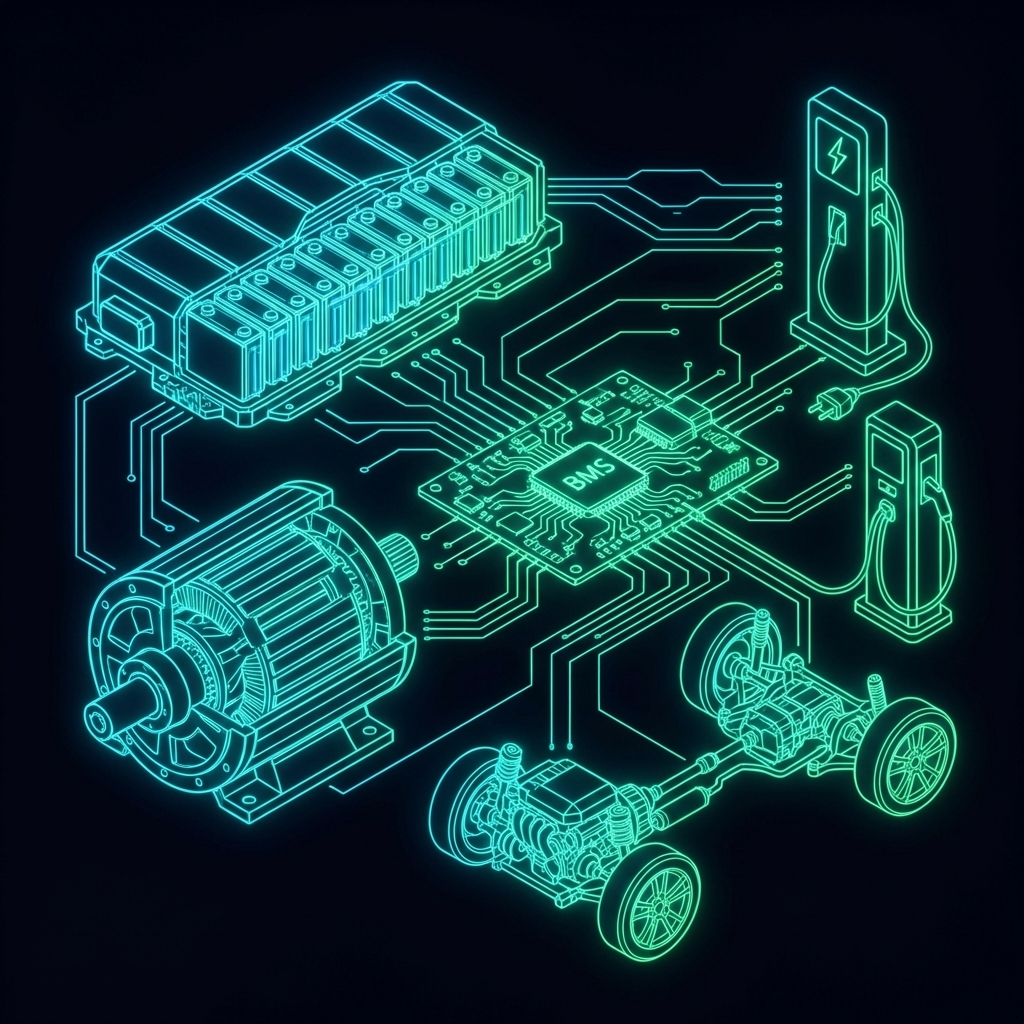
The battery pack is the most expensive and heaviest component in an EV — typically 30-40% of vehicle cost and 25-30% of curb weight. Understanding battery chemistry is crucial for making informed decisions about EV design, performance, and safety.
All modern EVs use lithium-ion (Li-ion) batteries, but "lithium-ion" is an umbrella term covering many different chemistries. The choice of cathode material dramatically affects energy density, power capability, cycle life, safety, and cost.
Lithium-Ion Cell Structure
Every Li-ion cell has four main components:
Sponsored
Harshal got placed at Fiat Chrysler as Design Engineer
Watch his video testimonial on how the program helped him
See His Journey
1. Cathode (Positive Electrode)
The chemistry differentiator — defines cell characteristics
Made of lithium metal oxides (LFP, NMC, NCA, etc.)
Lithium ions are stored here when the cell is charged
Coated on aluminum foil current collector
2. Anode (Negative Electrode)
Usually graphite (layered carbon structure)
Silicon-doped graphite emerging for higher energy density
Lithium ions intercalate between graphite layers during charging
Coated on copper foil current collector
3. Separator
Thin porous polymer membrane (PE or PP)
Prevents electrical contact between electrodes
Allows lithium ion transport through electrolyte
Shutdown feature: Melts at ~130°C to stop ion flow
Reverse process — lithium ions return to cathode, electrons power the motor.
The cell voltage depends on the electrochemical potential difference between cathode and anode materials. This is why different chemistries have different voltage ranges.
🎯3,000+ Engineers Placed
Sponsored
Harshal
Fiat Chrysler
Abhishek
TATA ELXSI
Srinithin
Xitadel
Ranjith
Core Automotive
Gaurav
Automotive Company
Bino
Design Firm
Aseem
EV Company
Puneet
Automotive Company
Vishal
EV Startup
More Success Stories
Cathode Chemistries Compared
The cathode material is what differentiates Li-ion variants. Each has tradeoffs:
Sponsored
Gaurav Jadhav is now a CAE Engineer
Practical projects and mock interviews made the difference
See His Journey
Click on each chemistry to see detailed specifications. Radar chart shows relative performance across key metrics.
LFP (Lithium Iron Phosphate)
Formula: LiFePO₄
Property
Value
Nominal voltage
3.2V
Energy density
90-160 Wh/kg
Cycle life
2000-5000 cycles
Thermal runaway
>250°C
Cost
Low (no cobalt)
Advantages:
Excellent thermal stability and safety
Long cycle life (ideal for commercial vehicles)
No cobalt (ethical and cost benefits)
Flat discharge curve (easy SOC estimation)
Disadvantages:
Lower energy density (larger/heavier pack)
Poor low-temperature performance
Lower voltage (more cells needed for same pack voltage)
Used in: Tata Nexon EV, BYD Blade Battery, Tesla Model 3 Standard Range
NMC (Nickel Manganese Cobalt)
Formula: LiNi_xMn_yCo_zO₂ (where x+y+z=1)
Common variants: NMC111, NMC532, NMC622, NMC811 (numbers = ratio)
Property
NMC111
NMC622
NMC811
Energy density
150-180 Wh/kg
180-210 Wh/kg
220-280 Wh/kg
Cycle life
1500-2000
1000-1500
800-1200
Safety
Good
Moderate
Lower
Cost
Moderate
Moderate
Higher (more Ni)
Higher nickel = higher energy density but lower stability. The industry is moving toward NMC811 for EVs to maximize range.
Used in: LG, Samsung SDI, SK Innovation cells for most premium EVs
The logarithmic terms capture the steep voltage changes at extreme SOC values (near 0% and 100%).
Key Observations
LFP: Very flat curve between 20-80% SOC. This makes SOC estimation challenging but provides consistent power delivery.
NMC/NCA: More linear relationship. Easier to estimate SOC from voltage, but voltage drops noticeably as battery depletes.
Temperature effect: OCV curves shift with temperature. At low temperatures, voltage is lower for the same SOC.
Cell Formats
Cells come in three main form factors:
Cylindrical (18650, 21700, 4680)
18650: 18mm diameter, 65mm length (laptop cells)
21700: 21mm × 70mm (Tesla Model 3, Lucid)
4680: 46mm × 80mm (Tesla's new tabless design)
Pros: Easy manufacturing, good thermal management, standardized
Cons: Wasted space in packing, many connections needed
Prismatic
Rectangular metal case
Capacity: 20-300 Ah per cell
Used by: BYD, CATL, Samsung SDI
Pros: Better space utilization, easier assembly
Cons: More expensive, harder thermal management
Pouch
Soft aluminum laminate packaging
Capacity: 10-100 Ah
Used by: LG, SK Innovation
Pros: Lightweight, flexible form factor, no wasted space
Cons: Requires structural support, swelling issues
Chemistry Selection for Indian Market
Indian EV manufacturers are increasingly choosing LFP for these reasons:
High ambient temperatures: LFP's thermal stability is advantageous
Cost sensitivity: No cobalt reduces cell cost by 30-40%
Cycle life: Important for commercial vehicles (autos, buses)
Supply chain: Less dependence on cobalt supply chain
Tata Motors transitioned the Nexon EV to LFP (from NMC) in 2023, citing better thermal performance in Indian conditions.
Safety: Thermal Runaway
Thermal runaway is a self-accelerating heating process that can cause fire or explosion:
LFP is safest and cheapest, but lowest energy density — ideal for India
NMC811 offers highest energy density but requires careful thermal management
NCA is used by Tesla for maximum range, but with sophisticated BMS
LTO enables ultra-fast charging but sacrifices energy density
OCV varies with SOC — this relationship is key for BMS algorithms
Chemistry choice involves tradeoffs between energy, power, life, safety, and cost
What's Next
In the next lesson, we'll learn how individual cells are combined into battery packs — understanding series/parallel configurations, pack voltage classes (400V vs 800V), and how to calculate pack specifications from cell data.
Career Growth
3,000+ Engineers Placed in Top Companies
Join the ranks of successful engineers at Bosch, Tata, L&T, and 500+ hiring partners.