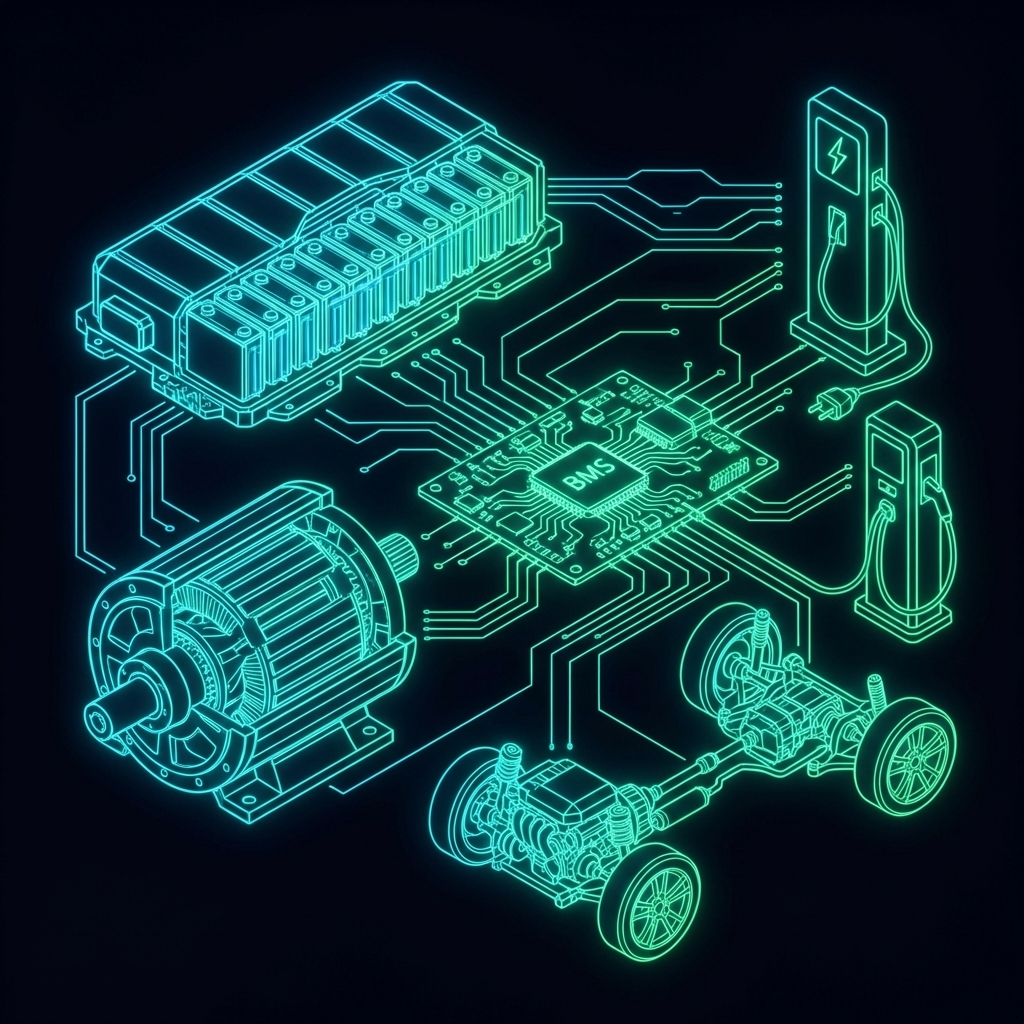
Power Electronics
Power electronics are the translators between battery (DC) and motor (AC). They control hundreds of kilowatts with microsecond precision, enabling the smooth torque delivery that makes EVs special.
Three-Phase Inverter
The heart of the EV powertrain is the traction inverter — it converts battery DC to variable-frequency AC for the motor.
Watch switching states and see how they create the three-phase AC output. Topology
Six-switch inverter:
3 half-bridges (one per phase)
6 power switches (IGBTs or MOSFETs)
6 freewheeling diodes
DC link capacitor
Each leg has two switches:
Sponsored
3,000+ engineers placed at Mahindra, Bosch, TATA ELXSI
Including Continental, Capgemini, Ola Electric & 500+ more companies
High-side: connects phase to DC+
Low-side: connects phase to DC-
Rule: Never turn both switches ON simultaneously (shoot-through → short circuit)
Switching States
State A B C VAB VBC VCA 000 L L L 0 0 0 100 H L L +Vdc 0 -Vdc 110 H H L 0 +Vdc -Vdc 010 L H L -Vdc +Vdc 0 011 L H H -Vdc 0 +Vdc 001 L L H 0 -Vdc +Vdc 101 H L H +Vdc -Vdc 0 111 H H H 0 0 0
Dead Time
When switching states, a brief dead time (0.5-2 μs) is inserted:
Prevents shoot-through during transition
Both switches OFF momentarily
Current flows through freewheeling diodes
Causes voltage distortion (must compensate)
DC Link Capacitor
Functions:
Smooths DC bus voltage ripple
Sources/sinks high-frequency current
Provides energy during switching transients
Sizing:
$$C_{dc} = \frac{I_{rms}}{2\pi f_{sw} \cdot \Delta V_{ripple}}$$
Types:
Film capacitors: High reliability, large volume
Electrolytic: Compact, limited life
Modern trend: Film capacitors for automotive
Power Flow
Adjust parameters to see power flow through the inverter and calculate losses. Motoring Mode (Battery → Motor)
$$P_{battery} = V_{dc} \times I_{dc}$$
Sponsored
Srinithin now works at Xitadel as Design Engineer
Mechanical engineering graduate turned automotive designer
$$P_{motor} = \sqrt{3} \times V_{line} \times I_{line} \times \cos\phi \times \eta_{motor}$$
$$P_{inverter} = P_{battery} \times \eta_{inverter}$$
Regeneration Mode (Motor → Battery)
During braking:
Sponsored
Abhishek landed his dream job at TATA ELXSI
From learning simulations to working at an industry leader
Motor acts as generator
Current direction reverses
Inverter acts as rectifier
Energy flows back to battery
Efficiency in regen typically 85-92% (motor + inverter).
Inverter Losses
Conduction Losses
When switch is ON:
$$P_{cond} = I_{rms}^2 \times R_{DS(on)}$$ (MOSFET)
$$P_{cond} = V_{CE(sat)} \times I_{avg} + I_{rms}^2 \times R_{CE}$$ (IGBT)
Switching Losses
Energy lost during each transition:
$$P_{sw} = f_{sw} \times (E_{on} + E_{off})$$
Factors affecting switching losses:
Switching frequency (higher → more losses)
DC bus voltage (higher → more energy per switch)
Current magnitude
Switch technology (SiC << Si)
Loss Breakdown (Typical 150 kW Inverter)
Component Loss (kW) % of Total IGBT conduction 1.2 40% IGBT switching 0.9 30% Diode conduction 0.6 20% Diode reverse recovery 0.3 10% Total 3.0 2% of rated
DC-DC Converters
EVs use multiple DC-DC converters:
High-Voltage DC-DC (400V → 12V)
Powers 12V accessories (lights, ECUs, infotainment):
Topology: Phase-shifted full-bridge or LLC resonant
Power: 1.5-3 kW continuous
Efficiency: 92-96%
Key specs:
Input: 250-450V (battery range)
Output: 12-14V regulated
Isolation: 2500V minimum
Boost Converter (Battery → Higher DC Bus)
Some EVs boost battery voltage for higher motor performance:
Example: 2024 Porsche Taycan
Battery: 800V
Boost available from lower voltage
Topology: Interleaved boost
Efficiency: 97-99%
Bidirectional DC-DC (for 48V Mild Hybrid)
Transfers energy between 48V and 12V systems:
Boost during acceleration assist
Buck during regeneration
Power Semiconductor Comparison
Silicon (Si) IGBT
Voltage rating: 600-1200V
Switching frequency: 10-20 kHz
Junction temp: 150-175°C
Cost: Low
Used in: Most current EVs
Silicon Carbide (SiC) MOSFET
Voltage rating: 650-1700V
Switching frequency: 20-100 kHz
Junction temp: 175-200°C
Cost: 3-5× Si
Advantages:
50% lower switching losses
Higher efficiency at part load
Smaller heat sink
Higher switching frequency → smaller passives
Used in: Tesla Model 3/Y, Porsche Taycan, Lucid Air
Gallium Nitride (GaN)
Voltage rating: 650V (currently)
Switching frequency: 100 kHz - 1 MHz
Advantages:
Very fast switching
Low gate charge
No reverse recovery
Current status: Emerging for OBC, DC-DC
Not yet: Traction inverters (voltage limited)
Comparison Table
Property Si IGBT SiC MOSFET GaN Voltage 1200V 1200V 650V On-resistance High Low Very low Switching loss High Low Very low Thermal limit 150°C 200°C 150°C Cost $ $$$$ $$$ Maturity High Medium Low
Onboard Charger (OBC)
Converts AC mains to DC for battery charging:
Topology
Stage 1: PFC (Power Factor Correction)
Boost converter topology
Shapes input current to sine wave
Achieves PF > 0.99
Stage 2: Isolated DC-DC
LLC resonant converter
Provides galvanic isolation
Regulates output voltage
OBC Specifications
Parameter Level 2 (3.3 kW) Level 2 (7.4 kW) Level 2 (11 kW) Input 230V, 16A 230V, 32A 400V 3-phase Output 200-450V DC 200-450V DC 200-450V DC Efficiency 92-94% 93-95% 94-96% Cooling Air Liquid Liquid
Bidirectional OBC (V2G)
Emerging technology:
Can export power from EV to grid
Requires bidirectional inverter stage
Enables vehicle-to-home (V2H)
Thermal Management
Power electronics generate significant heat:
Cooling Methods
Air cooling: Simple, limited power (<5 kW)
Liquid cooling (water-glycol):
Coldplate under power modules
Shared coolant loop with motor/battery
Most common for automotive
Direct cooling (double-sided):
Coolant contacts both sides of module
2× heat extraction
Emerging technology
Junction Temperature Limits
Device Max Tj Typical Operation Si IGBT 175°C 120-140°C SiC MOSFET 200°C 150-175°C Si Diode 175°C 120-140°C
Derating: Reduce power as temperature approaches limit.
EMI Considerations
High dV/dt switching creates EMI:
Sources
Switch turn-on/off (10-50 kV/μs)
Diode reverse recovery
Parasitic ringing
Mitigation
Shielded cables: Keep noise insideCommon mode chokes: Filter HF noiseSnubbers: Dampen ringingGate resistors: Slow down switching (trade EMI vs losses)Standards
CISPR 25: Automotive EMC limits
ISO 11452: Immunity testing
Indian Context
Two-Wheeler Inverters
Power: 3-8 kW
Voltage: 48-72V
Device: Si MOSFETs
Cost target: ₹8,000-15,000
Passenger Car Inverters
Power: 80-150 kW
Voltage: 350-450V
Device: Si IGBT or SiC MOSFET
Cost: ₹80,000-1,50,000
Suppliers in India
Sona Comstar: Inverters for TataKPIT: Software for PEMahle: Thermal managementContinental: Power electronicsKey Takeaways
Six-switch inverter converts battery DC to motor ACSVPWM synthesizes desired voltage using 8 switch statesLosses = conduction + switching (2-4% of rated power)SiC MOSFETs offer 50% lower losses than Si IGBTsOBC uses PFC + isolated DC-DC stagesThermal management is critical — liquid cooling standardWhat's Next
In the next lesson, we'll explore the complete EV Powertrain — how motor, inverter, gearbox, and differential work together to propel the vehicle.