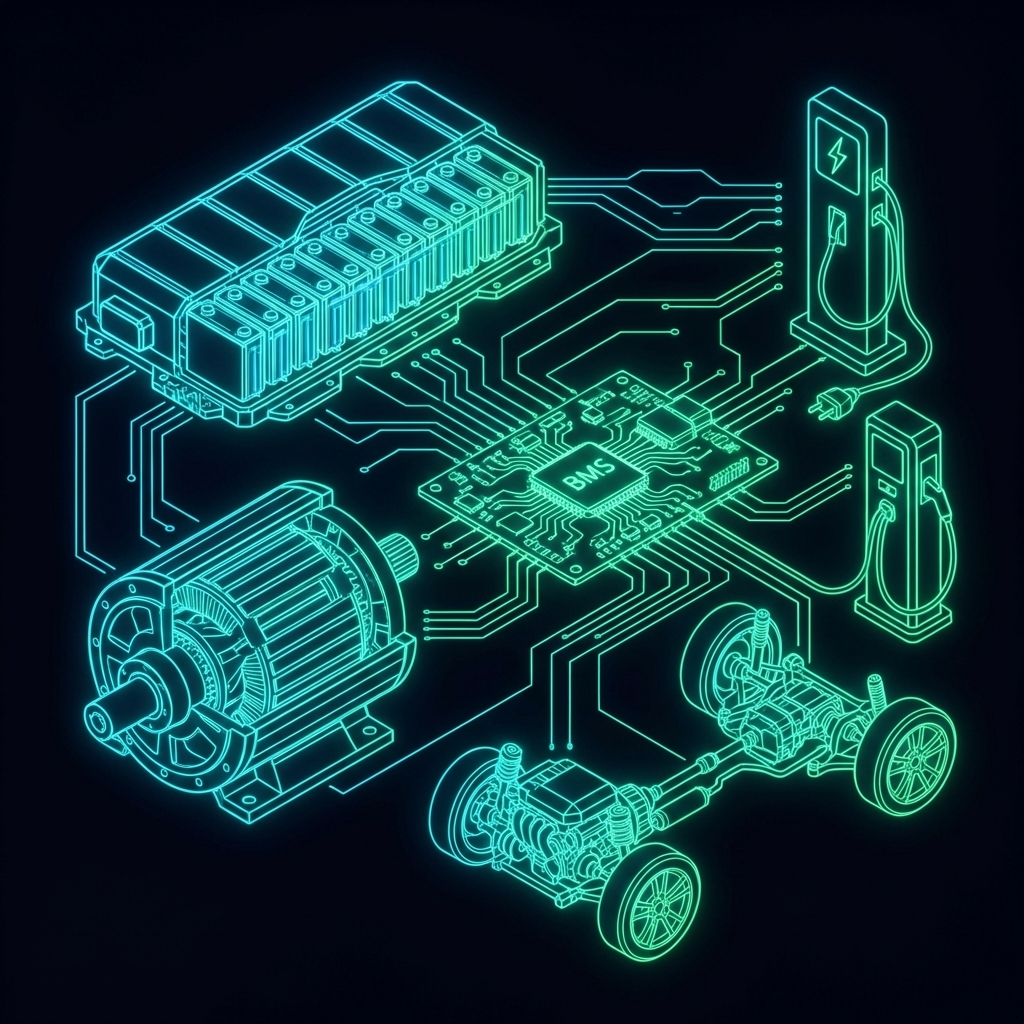
Charging is how EVs "refuel." Understanding charging standards, power levels, and charging curves is essential for EV adoption. India is rapidly building charging infrastructure, but compatibility and availability remain key concerns.
Charging Levels
AC Charging (Level 1 & 2)
AC charging uses the vehicle's onboard charger (OBC) to convert AC mains to DC for the battery.
Level 1 (Slow):
Power: 1.4-2.4 kW
Connector: Standard household plug
Use case: Emergency/overnight charging
Time: 20-40 hours for full charge
Level 2 (Standard):
Power: 3.3-22 kW
Connector: Type 2 (Europe/India), Type 1 (US/Japan)
Use case: Home, workplace, public
Time: 4-10 hours for full charge
DC Fast Charging (Level 3)
DC charging bypasses the onboard charger. The charging station itself converts AC to DC and feeds the battery directly.
Standard
Max Power
Regions
Notes
CCS1
350 kW
USA
Combined AC/DC connector
CCS2
350 kW
Europe, India
Combined AC/DC connector
CHAdeMO
100 kW
Japan, legacy
Being phased out
GB/T
250 kW
China
Mandated in China
Tesla NACS
250 kW
USA (Tesla)
Opening to others
Click each connector type to see specifications and regional availability.
Charging Time Calculator
Adjust battery size, charger power, and see realistic charging time with taper curve.
Why Charging Slows Down
Charging follows a CC-CV (Constant Current - Constant Voltage) profile:
The exact tools used by Mahindra, Bosch & TATA ELXSI
See All Tools
Actual time: ~45 minutes (includes taper and derating)
🎯3,000+ Engineers Placed
Sponsored
Harshal
Fiat Chrysler
Abhishek
TATA ELXSI
Srinithin
Xitadel
Ranjith
Core Automotive
Gaurav
Automotive Company
Bino
Design Firm
Aseem
EV Company
Puneet
Automotive Company
Vishal
EV Startup
More Success Stories
Indian Charging Standards
Bharat Standards
Bharat AC-001:
Power: 3.3 kW
Connector: IEC 60309 (industrial plug)
Voltage: 230V, single phase
Current: 15A
Bharat DC-001:
Power: 15 kW
Connector: GB/T based
Voltage: 72-200V DC
Current: 200A max
CCS2 Adoption
India has adopted CCS2 as the standard for DC fast charging:
All new DC chargers must support CCS2
Most new EVs come with CCS2 port
Interoperability with European standards
Charging Infrastructure
Public charging networks (2024):
Tata Power: 4,000+ chargers
EESL: 2,000+ chargers
Ather Grid: 1,500+ (two-wheeler focused)
ChargeZone, Statiq, Kazam: Growing networks
Challenges:
Limited DC fast charging outside highways
Inconsistent pricing across networks
App fragmentation (each network has own app)
Charging Curves
Factors Affecting Charging Speed
1. Battery Temperature:
Cold battery (<15°C): Reduced charging speed
Optimal (25-35°C): Full speed
Hot (>40°C): Reduced to prevent damage
2. State of Charge:
0-50%: Full speed typically
50-80%: May start tapering
80-100%: Significant taper
3. Battery Health (SOH):
Degraded batteries accept less current
BMS limits charging to protect cells
4. Charger Limitations:
Shared power with other vehicles
Grid constraints
Cable current limits
Peak vs Sustained Power
Marketing claims often use peak charging power:
Sponsored
April batch closing soon — only 42 seats remaining
Join 3,000+ engineers who got placed at top companies
Reserve Your Seat
Porsche Taycan: "270 kW charging"
Actual: 270 kW for a few minutes, then tapers
Useful metric: Time for 10-80% charge (more honest)
Onboard Charger (OBC)
The OBC limits AC charging speed:
Vehicle
OBC Power
AC Charge Rate
Nexon EV
3.3 kW
~15 hours (0-100%)
MG ZS EV
7.4 kW
~7 hours
Mercedes EQS
22 kW
~3 hours
Ather 450X
1.3 kW
~5 hours
Upgrading OBC: Some vehicles offer higher-power OBC as option.
Charging Economics
Cost Comparison (India, 2024)
Method
Cost (₹/kWh)
Cost per 100 km
Home (night tariff)
₹5-7
₹60-85
Public AC
₹10-15
₹120-180
DC Fast Charging
₹15-25
₹180-300
Petrol (15 km/L)
-
₹600-700
Savings: EVs cost 70-90% less per km than petrol vehicles.
Charging at Home
Requirements:
Dedicated 15A/16A circuit
Earthing/grounding essential
Smart charger recommended (scheduling, metering)
Installation cost: ₹5,000-20,000
Battery Preconditioning
For optimal DC fast charging:
Preconditioning: Heat/cool battery to optimal temperature before arrival at charger.
Tesla approach: Automatically preconditions when navigating to Supercharger.
Benefits:
Faster charging (10-20% improvement)
Less stress on battery
Better cold weather performance
Vehicle-to-Grid (V2G)
Emerging technology allowing EVs to export power:
Applications:
Peak shaving (export during high demand)
Backup power for home
Grid stabilization
Requirements:
Bidirectional charger
Smart metering
Grid operator agreement
Status in India: Pilot projects, not widespread.
Key Takeaways
AC charging (Level 2) is best for home/overnight; DC fast charging for highways
India uses CCS2 standard for DC fast charging
Charging tapers significantly after 80% SOC
Real charging time is longer than simple calculation due to taper
Home charging is 70-90% cheaper than petrol
Battery temperature significantly affects charging speed
What's Next
In the next lesson, we'll explore Range & Efficiency — understanding what affects EV range, drive cycles, and how to maximize efficiency.
Career Growth
3,000+ Engineers Placed in Top Companies
Join the ranks of successful engineers at Bosch, Tata, L&T, and 500+ hiring partners.