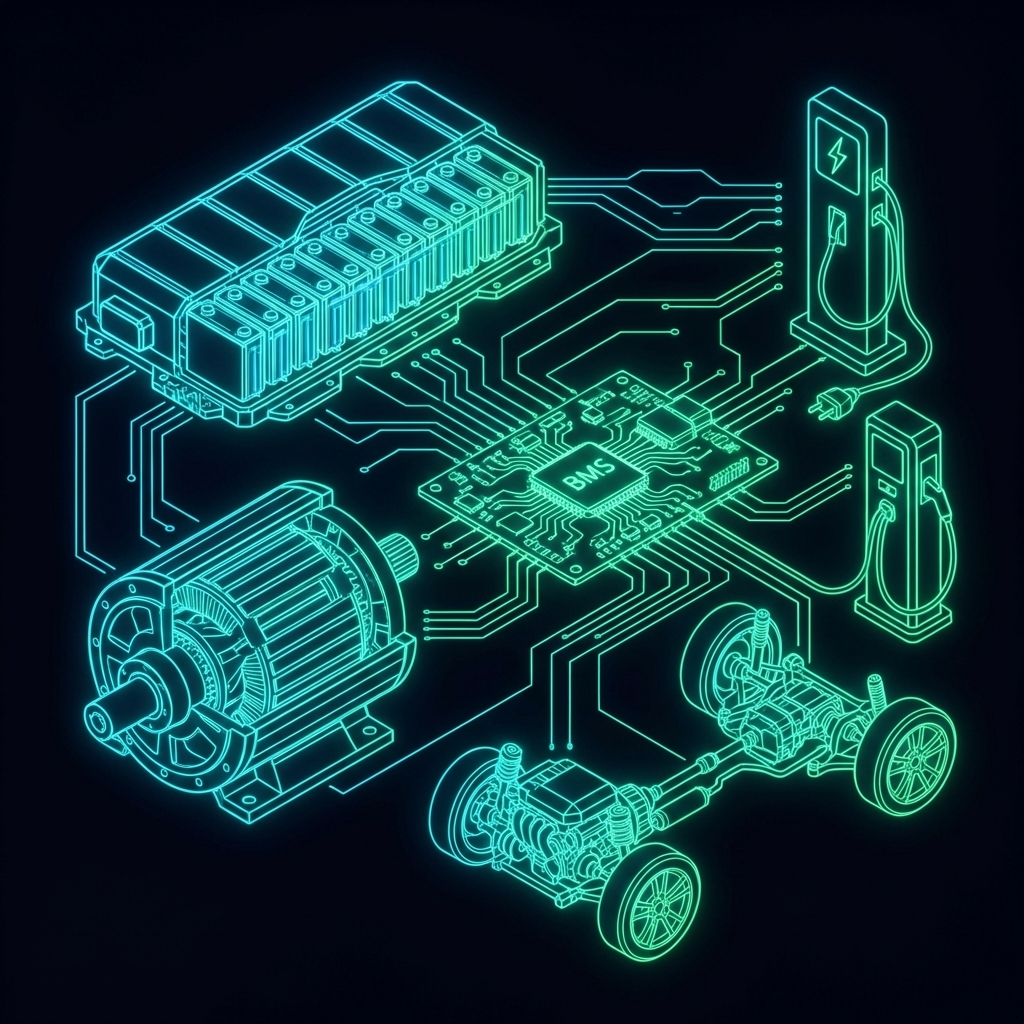
The electric motor is the muscle of an EV. Unlike internal combustion engines that need complex transmissions to deliver usable torque, electric motors provide instant torque from zero RPM and maintain high efficiency across a wide speed range.
Why Electric Motors Excel
Instant torque: Maximum torque available from standstill — no clutch, no gear changes.
High efficiency: 90-96% vs 20-30% for ICE engines.
Regenerative braking: Motors become generators during deceleration, recovering energy.
Simplicity: Few moving parts, no oil changes, minimal maintenance.
Motor Types in EVs
Click on each motor type to see construction details and characteristics.
PMSM (Permanent Magnet Synchronous Motor)
Construction:
Rotor with permanent magnets (NdFeB)
Stator with 3-phase windings
Rotor speed = synchronous speed (no slip)
Characteristics:
Highest efficiency (96%+)
Highest power density
Best for passenger EVs
Used in: Tesla Model 3/Y, Tata Nexon EV, Ather 450X, Ola S1
Induction Motor (IM)
Construction:
Rotor with aluminum cage (squirrel cage)
Stator with 3-phase windings
Rotor runs slightly slower than field (slip)
Characteristics:
No permanent magnets (no rare earth dependence)
Rugged and reliable
Lower efficiency than PMSM
Higher mass for same power
Used in: Tesla Model S/X (rear), Tata Tigor EV
BLDC (Brushless DC Motor)
Construction:
Similar to PMSM but trapezoidal back-EMF
Hall sensors for commutation
Simpler control than PMSM
Characteristics:
Lower cost than PMSM
Good for low-power applications
Common in two-wheelers
Used in: Many e-scooters, e-rickshaws
IPM (Interior Permanent Magnet)
Construction:
Magnets embedded inside rotor
V-shaped or spoke arrangement
Combines magnet and reluctance torque
Characteristics:
Better field weakening than SPM
Wider speed range
Standard for automotive
Used in: Most modern EV motors
Torque-Speed Characteristics
Adjust motor parameters to see how the torque-speed curve changes.
The EV Advantage
Constant Torque Region (0 to base speed):
Maximum torque available from 0 RPM
Limited by motor current capacity
Perfect for acceleration from stop
Constant Power Region (above base speed):
Torque decreases as speed increases
Power = Torque × Speed stays constant
Field weakening reduces back-EMF
Mathematical Relationships
Torque equation:
$$T = K_t \times I_q$$
Where $K_t$ is torque constant and $I_q$ is q-axis current.
Sponsored
Ranjith switched from IT to core automotive industry
His inspiring career transition story with video
See His Journey
Back-EMF:
$$E = K_e \times \omega$$
Where $K_e$ is back-EMF constant and $\omega$ is angular velocity.
Base speed (transition point):
$$\omega_{base} = \frac{V_{max}}{K_e}$$
Sponsored
Get an IIT Jammu PG certification
Recognized by Mahindra, Bosch, TATA ELXSI & 500+ companies
See Program Details
Field weakening region:
$$T \propto \frac{1}{\omega}$$ (constant power)
Why No Gearbox Needed
ICE engines produce peak torque at high RPM (4000-6000). EVs produce peak torque at 0 RPM.
Vehicle
Peak Torque
@ RPM
Petrol car
150 Nm
4500
Diesel car
200 Nm
2000
EV
250 Nm
0
A single-speed reduction gear (8:1 to 12:1) is enough. No clutch, no shifting.
Sponsored
70% of India's auto industry trusts Skill-Lync
For training their engineers in CAD, CAE & simulation
Learn More
🎯3,000+ Engineers Placed
Sponsored
Harshal
Fiat Chrysler
Abhishek
TATA ELXSI
Srinithin
Xitadel
Ranjith
Core Automotive
Gaurav
Automotive Company
Bino
Design Firm
Aseem
EV Company
Puneet
Automotive Company
Vishal
EV Startup
More Success Stories
Efficiency Maps
Real motor efficiency varies with torque and speed:
Peak efficiency zone: 85-95% in a "sweet spot"
Typically at moderate torque, moderate speed
Drive cycle optimization targets this zone
Low efficiency regions:
Very low speed (high current, low power)
Very high speed (high windage losses)
Very high torque (high copper losses)
Losses in Electric Motors
Copper losses (I²R):
Dominant at high torque
Increase with current squared
Iron losses (hysteresis + eddy):
Dominant at high speed
Increase with frequency
Mechanical losses:
Bearing friction
Windage (air resistance)
Motor Specifications
Key Parameters
Parameter
Symbol
Unit
Typical Value
Peak power
P_peak
kW
100-300
Continuous power
P_cont
kW
50-150
Peak torque
T_peak
Nm
200-500
Continuous torque
T_cont
Nm
100-250
Max speed
n_max
RPM
12,000-20,000
Base speed
n_base
RPM
3,000-6,000
Efficiency
η_peak
%
94-97
Example: Tata Nexon EV Motor
Type: PMSM
Peak power: 105 kW (143 PS)
Peak torque: 245 Nm
Max speed: 10,000 RPM (estimated)
Gear ratio: ~8:1
Cooling Requirements
Electric motors generate significant heat:
Heat sources:
Stator windings (copper losses)
Rotor (iron losses, magnet losses)
Bearings (friction)
Cooling methods:Air cooling: Simple, sufficient for low power
Used in: e-scooters, small EVs
Liquid cooling (water-glycol): Most common
Cooling jacket around stator
10-15 kW heat rejection typical
Used in: Nexon EV, Model 3
Oil cooling: Best thermal contact
Oil sprayed directly on windings
Complex sealing requirements
Used in: High-performance EVs
Magnets and Rare Earths
PMSM motors use neodymium-iron-boron (NdFeB) magnets:
Advantages:
Highest magnetic strength (Br = 1.2-1.4 T)
Enables compact, efficient motors
Concerns:
Rare earth supply (China dominates)
Price volatility
Ethical sourcing issues
Alternatives being developed:
Magnet-free motors (SRM, wound-rotor)
Ferrite magnets (lower performance)
Recycled magnets
Indian Context
Two-wheelers: BLDC and PMSM dominate
Ather 450X: 6 kW PMSM
Ola S1 Pro: 8.5 kW IPM
Passenger cars: PMSM standard
Nexon EV: 105 kW PMSM
MG ZS EV: 130 kW PMSM
Commercial vehicles: Mix of IM and PMSM
Tata Ace EV: IM
BYD e6: PMSM
Key Takeaways
PMSM is the dominant motor type in modern EVs due to high efficiency
Instant torque from 0 RPM eliminates need for multi-speed transmission
The torque curve has constant torque and constant power regions
Motor efficiency varies with operating point; drive cycle affects energy use
Liquid cooling is necessary for sustained high-power operation
Rare earth magnets are critical but supply chain risks exist
What's Next
In the next lesson, we'll learn Motor Control — how inverters and Field Oriented Control (FOC) enable precise torque control, and the Clarke/Park transformations that make it possible.
Career Growth
3,000+ Engineers Placed in Top Companies
Join the ranks of successful engineers at Bosch, Tata, L&T, and 500+ hiring partners.