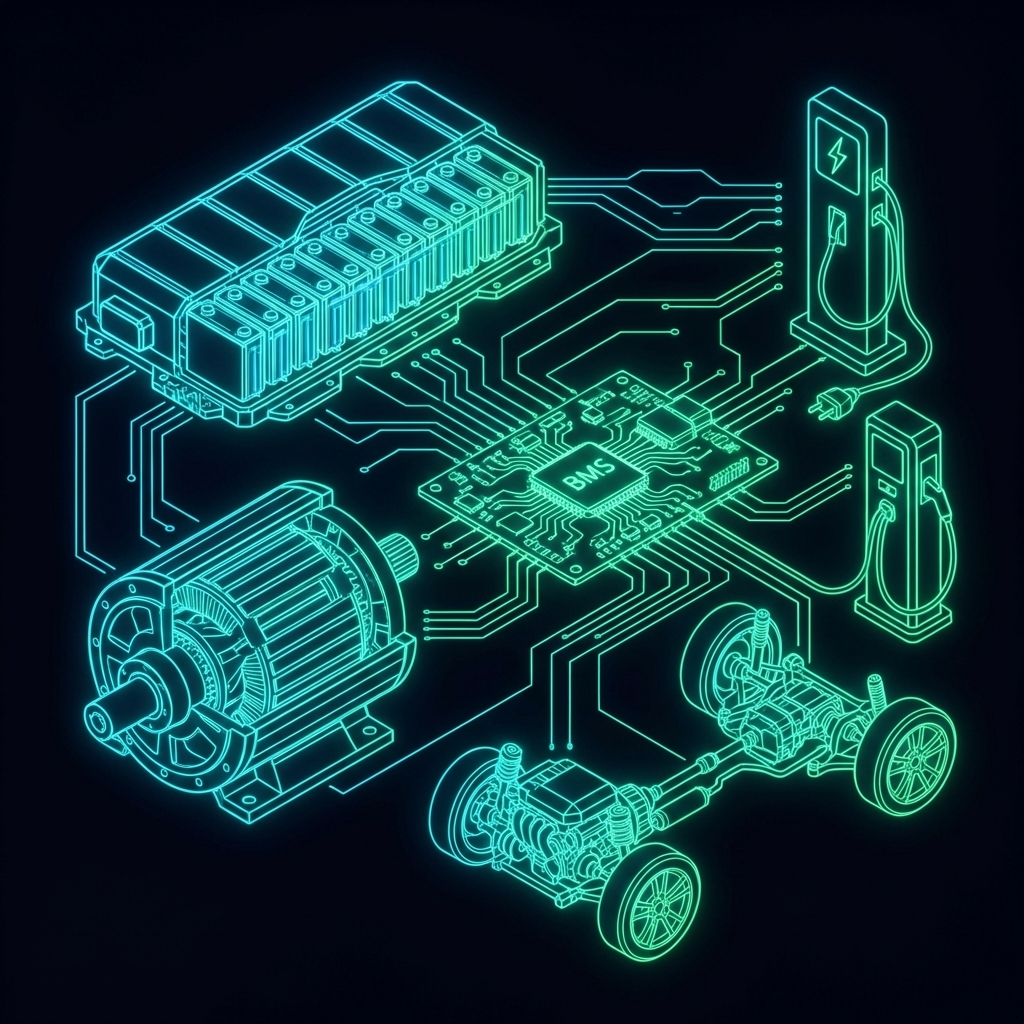
Introduction to Electric Vehicles
The automotive industry is undergoing its biggest transformation since the invention of the internal combustion engine. Electric vehicles are no longer a niche technology — they're becoming the mainstream choice for transportation worldwide.
In India, this transition is accelerating rapidly. From Tata's Nexon EV dominating the market to Ather and Ola revolutionizing two-wheelers, EVs are reshaping how we think about mobility.
Why Electric Vehicles?
Three fundamental forces are driving the EV revolution:
Srinithin now works at Xitadel as Design Engineer
Mechanical engineering graduate turned automotive designer
- Transportation accounts for ~16% of global CO₂ emissions
- ICE vehicles emit NOx, particulate matter, and unburnt hydrocarbons
- EVs produce zero tailpipe emissions (though upstream emissions depend on grid mix)
- Electricity costs ₹1-2 per km vs ₹6-8 per km for petrol
- EVs have fewer moving parts: no oil changes, no clutch, simpler transmission
- Total cost of ownership becomes competitive at 50,000+ km
- Instant torque from zero RPM
- Smooth, silent operation
- Lower center of gravity (battery in floor) improves handling
Types of Electric Vehicles
Not all EVs are the same. Understanding the classifications helps you appreciate the technology choices:
BEV (Battery Electric Vehicle)
- 100% electric — no internal combustion engine
- Powered entirely by battery pack
- Examples: Tata Nexon EV, MG ZS EV, Ather 450X
- Range: 150-500 km depending on battery size
- Charging: AC home charging + DC fast charging
HEV (Hybrid Electric Vehicle)
- Combines ICE with small electric motor
- Battery charged only through regenerative braking (no plug-in)
- Examples: Toyota Camry Hybrid, Honda City Hybrid
- Improves fuel efficiency by 20-30%
- Cannot run on pure electric for extended periods
PHEV (Plug-in Hybrid Electric Vehicle)
- Larger battery than HEV, can be plugged in to charge
- Offers 30-80 km of pure electric range
- ICE serves as range extender
- Examples: BMW X5 PHEV, Volvo XC90 PHEV
- Best of both worlds for those with range anxiety
FCEV (Fuel Cell Electric Vehicle)
- Uses hydrogen fuel cell to generate electricity
- Only emission is water vapor
- Refueling takes 3-5 minutes like petrol
- Examples: Toyota Mirai, Hyundai Nexo
- Limited infrastructure in India currently
EV Architecture
An electric vehicle's powertrain is fundamentally different from an ICE vehicle. Let's explore the key components:
Battery Pack
The heart of an EV. Stores electrical energy in lithium-ion cells.
3,000+ engineers placed at top companies in 2024
Mahindra, Bosch, TATA ELXSI, Capgemini and more
- Typical capacity: 30-100 kWh for cars, 2-5 kWh for two-wheelers
- Voltage: 48V (mild hybrid) to 800V (high-performance EVs)
- Weight: 300-600 kg for passenger cars
- Contains thousands of individual cells arranged in modules
Electric Motor
Converts electrical energy to mechanical motion.
- Types: PMSM (most common), Induction, BLDC
- Power: 50-300+ kW for cars, 3-10 kW for two-wheelers
- Efficiency: 90-95% (vs 25-30% for ICE)
- Provides instant torque from standstill
Inverter
The brain of motor control.
- Converts DC from battery to AC for motor
- Controls motor speed and torque via PWM
- Uses IGBTs or SiC MOSFETs for high-efficiency switching
- Handles bidirectional power flow for regenerative braking
Battery Management System (BMS)
The guardian of battery safety and health.
175+ hours of industry projects & 12 IIT faculty sessions
Master CATIA, NX, LS-DYNA, HyperMesh and more
- Monitors cell voltages, temperatures, and current
- Balances cells to ensure uniform charge/discharge
- Prevents overcharging, over-discharging, and thermal runaway
- Estimates State of Charge (SOC) and State of Health (SOH)
Onboard Charger (OBC)
Enables AC charging from home/public outlets.
- Converts AC (230V single-phase or 415V three-phase) to DC
- Power levels: 3.3 kW to 22 kW
- DC fast charging bypasses OBC, connecting directly to battery
Thermal Management System
Keeps all components in optimal temperature range.
- Battery: 25-35°C for best performance and longevity
- Motor and inverter: Liquid-cooled for high power
- Cabin: Heat pump HVAC (more efficient than resistive heating)