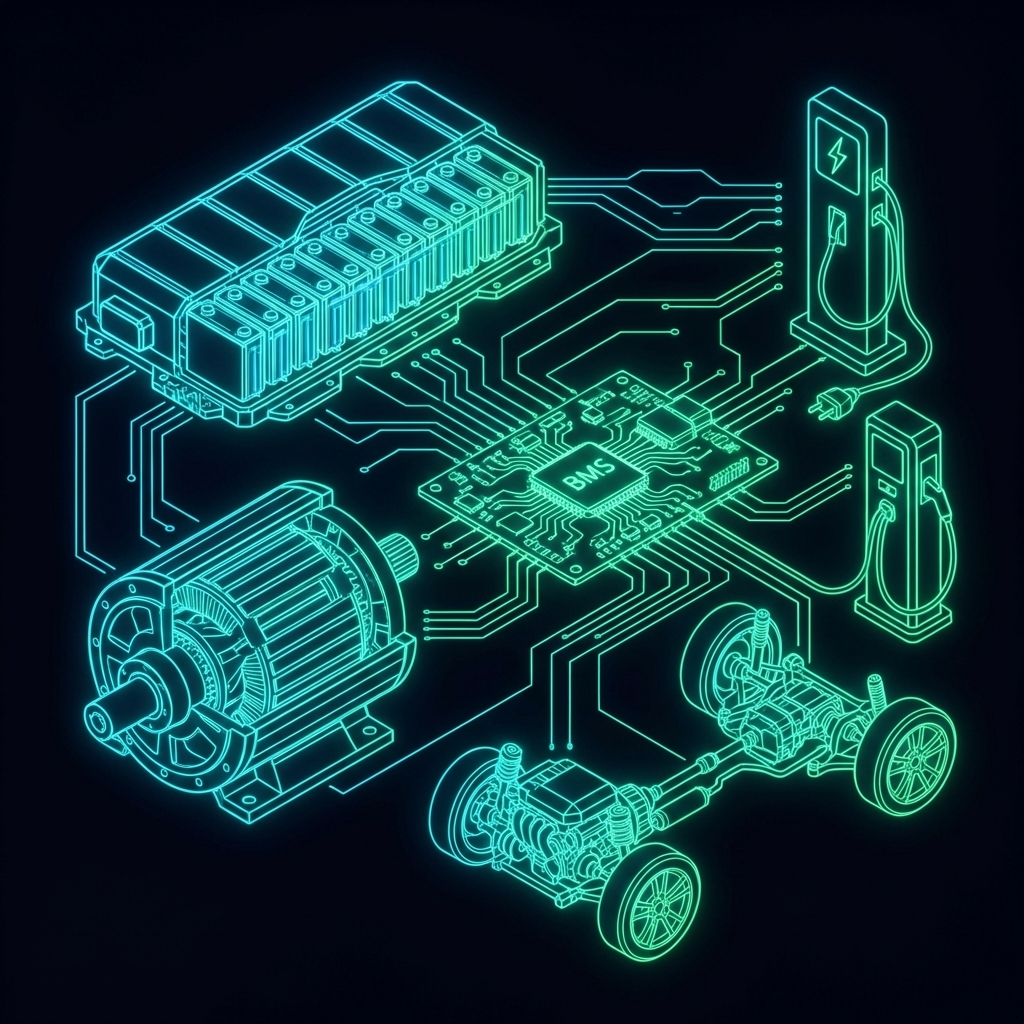
EV Powertrain
The EV powertrain is elegantly simple compared to ICE vehicles — no clutch, no multi-speed transmission, no exhaust system. Yet it delivers superior performance with instant torque and seamless acceleration.
Powertrain Architectures
Single Motor (Front or Rear)
Layout: Motor + reducer + differential
Advantages:
Simple, cost-effective
Fewer components
Lower weight
Examples:
Tata Nexon EV (front motor)
Nissan Leaf (front motor)
Ather 450X (hub motor)
Dual Motor (AWD)
Layout: One motor per axle
Advantages:
All-wheel drive
Torque vectoring possible
Redundancy
Examples:
Tesla Model 3 Long Range
Hyundai Ioniq 5 AWD
MG ZS EV AWD variants
Quad Motor
Layout: One motor per wheel
Advantages:
Ultimate torque vectoring
No mechanical differential
Maximum traction control
Examples:
Rivian R1T
Mercedes EQG (upcoming)
Vehicle Dynamics Calculator
Adjust vehicle parameters to calculate 0-100 km/h time and top speed. Forces on Vehicle
Tractive force (motor):
$$F_{motor} = \frac{T_{motor} \times G_r \times \eta_t}{r_{wheel}}$$
Where:
Sponsored
Srinithin now works at Xitadel as Design Engineer
Mechanical engineering graduate turned automotive designer
T_motor = motor torque (Nm)
G_r = gear ratio
η_t = transmission efficiency (~95%)
r_wheel = wheel radius (m)
Rolling resistance:
$$F_{roll} = m \times g \times C_{rr} \times \cos\theta$$
Typical Crr values:
Low rolling resistance tires: 0.006-0.008
Standard tires: 0.010-0.012
Aerodynamic drag:
$$F_{aero} = \frac{1}{2} \times \rho \times C_d \times A \times v^2$$
Sponsored
3,000+ engineers placed at top companies in 2024
Mahindra, Bosch, TATA ELXSI, Capgemini and more
Where:
ρ = air density (1.225 kg/m³)
Cd = drag coefficient (0.22-0.35)
A = frontal area (2.0-2.5 m²)
v = velocity (m/s)
Grade resistance:
$$F_{grade} = m \times g \times \sin\theta$$
Acceleration Equation
$$a = \frac{F_{motor} - F_{roll} - F_{aero} - F_{grade}}{m \times (1 + I_{eq})}$$
Sponsored
Abhishek landed his dream job at TATA ELXSI
From learning simulations to working at an industry leader
Where I_eq accounts for rotational inertia (~0.05).
0-100 km/h Calculation
Integrate acceleration over velocity:
$$t_{0-100} = \int_0^{27.78} \frac{1}{a(v)} dv$$
Approximation for quick estimate:
$$t_{0-100} \approx \frac{m \times v_{100}^2}{2 \times P_{avg}}$$
Maximum Speed
Limited by:
Motor speed: ω_max × r_wheel / G_rPower balance: F_motor = F_roll + F_aeroAt top speed, motor power = road load power:
$$P_{motor} = \frac{1}{2} \rho C_d A v_{max}^3 + m g C_{rr} v_{max}$$
Transmission
Single-Speed Reducer
Most EVs use a fixed-ratio gearbox:
Vehicle Gear Ratio Motor Max RPM Top Speed Tesla Model 3 9.0:1 17,000 225 km/h Nexon EV 8.0:1 10,000 120 km/h Ather 450X 10.0:1 8,500 90 km/h
Why single-speed works:
Electric motors have wide power band
Peak torque from 0 RPM
No need to stay in "power band"
Two-Speed Transmission
Emerging for high-performance EVs:
Advantages:
Better efficiency at highway speeds
Higher top speed without oversized motor
Challenges:
Added complexity and weight
Shift quality concerns
Cost
Examples: Porsche Taycan (2-speed rear)
Differential
Distributes torque between left and right wheels:
Open Differential
Simple mechanical device
Equal torque to both wheels
Wheel with less traction gets all power (limitation)
Electronic Limited Slip (eLSD)
Brake-based torque vectoring
Computer applies brake to spinning wheel
Redirects torque to gripping wheel
Dual Motor Torque Vectoring
Independent motor control per axle
No mechanical differential needed
True torque vectoring between front/rear
Regenerative Braking
See how energy flows during regeneration and calculate recovered energy. How It Works
Driver lifts accelerator or presses brake
Motor switches to generator mode
Kinetic energy → electrical energy
Energy stored back in battery
Regen Power
$$P_{regen} = F_{braking} \times v \times \eta_{motor} \times \eta_{inverter}$$
Typical efficiency: 70-85% overall
Energy Recovered
For a stop from velocity v:
$$E_{recovered} = \frac{1}{2} m v^2 \times \eta_{regen}$$
Example: 1500 kg vehicle stopping from 100 km/h:
$$E_{kinetic} = \frac{1}{2} \times 1500 \times 27.78^2 = 578 \text{ kJ} = 0.16 \text{ kWh}$$
$$E_{recovered} = 0.16 \times 0.80 = 0.13 \text{ kWh}$$
Blended Braking
Modern EVs blend regen + friction braking:
Low deceleration (<0.2g): Regen only
Medium deceleration (0.2-0.5g): Mostly regen + some friction
Emergency braking (>0.5g): Regen + full friction
One-Pedal Driving
Strong regen allows driving with accelerator only:
Lift off → car slows significantly (up to 0.3g)
Nearly stop without brake pedal
Popular in: Nissan Leaf, Tesla, MG ZS EV
Regen Limitations
Battery full: Cannot accept charge → reduced regen
Cold battery: High internal resistance → limited regen
High speed: Motor current limits may apply
ABS intervention: Regen reduced to prevent wheel lock
Efficiency Analysis
Energy Flow (Motoring)
Battery → Inverter → Motor → Gearbox → Wheels → Road
  100%      97%       94%      97%      95%     ~85%
Energy Flow (Regeneration)
Road → Wheels → Motor → Inverter → Battery
 100%   95%      88%      97%       ~80%
Drive Cycle Efficiency
Efficiency varies with driving pattern:
Condition Efficiency City stop-go 75-85% Highway cruise 85-90% Mountain driving 70-80%
Regen significantly helps city efficiency.
Gradeability
Ability to climb hills:
$$\text{Grade} \% = \tan(\theta) \times 100$$
$$\theta_{max} = \arcsin\left(\frac{F_{max} - F_{roll} - F_{aero}}{m \times g}\right)$$
Typical requirements:
Highway merge: 6% grade at 80 km/h
Parking structures: 15% at 20 km/h
Off-road: 30% at walking speed
Example: Nexon EV Gradeability
Motor torque: 245 Nm
Gear ratio: 8.0
Wheel radius: 0.32 m
Vehicle mass: 1550 kg
$$F_{max} = \frac{245 \times 8.0 \times 0.95}{0.32} = 5816 \text{ N}$$
$$\theta_{max} = \arcsin\left(\frac{5816}{1550 \times 9.81}\right) = 22.6°$$
$$\text{Grade} = \tan(22.6°) \times 100 = 41.6\%$$
Powertrain Integration
E-Axle (Integrated Drive Unit)
Modern trend: combine motor + inverter + gearbox:
Benefits:
Compact package
Optimized cooling
Reduced wiring
Lower cost
Suppliers: Bosch, BorgWarner, Nidec, ZF
Cooling Integration
Shared thermal system:
Battery coolant loop (25-35°C)
Powertrain coolant loop (50-70°C)
Chiller connecting both
HV Architecture
400V systems:
Current standard
Proven technology
Adequate for most EVs
800V systems:
Faster charging (350 kW+)
Lower current → thinner cables
Higher efficiency at high power
Examples: Porsche Taycan, Hyundai Ioniq 5
Indian EV Powertrains
Two-Wheelers
Model Motor Power Torque Transmission Ather 450X PMSM 6 kW 26 Nm Belt drive Ola S1 Pro IPM 8.5 kW 58 Nm Belt drive TVS iQube BLDC 4.4 kW 140 Nm (wheel) Hub motor
Passenger Vehicles
Model Config Motor Power Torque Nexon EV FWD PMSM 105 kW 245 Nm MG ZS EV FWD PMSM 130 kW 280 Nm XUV400 FWD PMSM 110 kW 310 Nm
Key Takeaways
Single motor with fixed-ratio gearbox is most commonVehicle acceleration depends on motor torque, mass, and drag
Regenerative braking recovers 70-85% of braking energySingle-speed transmission works because of motor's wide torque bandE-axle integration is the modern trend800V architecture enables faster chargingWhat's Next
In the next lesson, we'll explore Charging Systems — the different charging levels, connector standards, and how charging curves work.